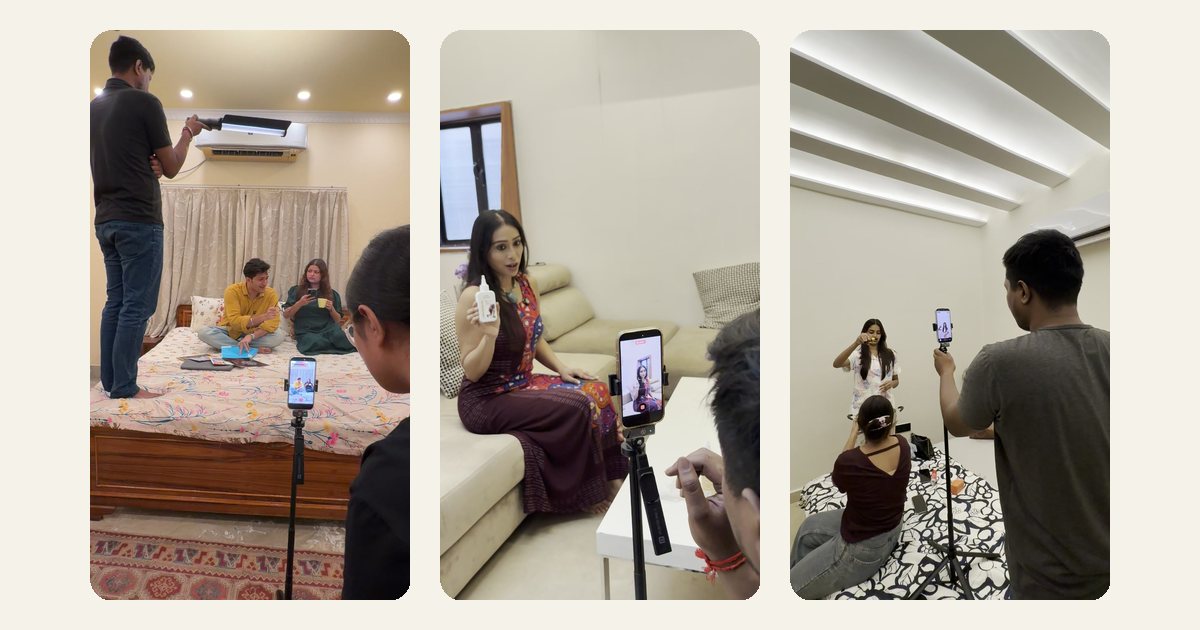
Scroll past enough Instagram Reels and you notice something: the polished brand ad with the cinematic grade gets skipped. The shaky phone video of a real person holding the same product gets watched to the end. This gap, between production value and persuasion, is not an accident. It is wired into how the human brain processes trust, and understanding it changes how you brief creators, structure videos, and allocate your content budget.
At The UGC Agency, every creative brief we build starts with a psychological question before it reaches a format question: why would this person's brain believe this? Here is what that looks like in practice.
Social Proof Is Not Just a Marketing Tactic, It Is a Survival Shortcut
Humans are wired to look at what others do when they are uncertain. Psychologists call this informational social influence: when we do not have direct experience with something, we borrow the experience of people who look like us. A brand ad is produced by people with an obvious financial stake in the sale. A customer video is produced by someone with nothing to gain from convincing you.
This is why we consistently brief creators to front-load their videos with a specific, personal context: not "I love this face wash" but "I have been breaking out along my jaw since I moved to Bengaluru two years ago, and I have tried four things that did not work." That level of specificity, the jaw, Bengaluru, the number four, signals to a viewer's brain that this is real memory, not scripted copy. The credibility is not in the claim; it is in the texture of the detail.
- Generic testimonial: "This product changed my skin."
- Credible UGC brief: "Three weeks after switching to this, my dermatologist noticed the difference before I told her I had changed anything."
The second version works because it includes an independent third-party observation, the dermatologist, and a timeline. Both are details that someone fabricating a testimonial is unlikely to invent. That believability is the conversion engine.
The Fluency Effect: Why "Rough" Feels Real
There is a cognitive bias called processing fluency: information that is easier to process feels more familiar, and familiar things feel safer. But there is a counterintuitive twist, when the context is social (a person speaking to camera, a review, a how-to), slightly rough production signals authenticity. A perfect studio background and precise lighting cues the viewer's brain that this is an advertisement. A slightly noisy kitchen, or a creator filming from their apartment in Pune at 7 PM with one ring light, reads as a peer's recommendation.
We test this directly. In A/B briefs for the same product, creators filmed in natural, ambient-light settings consistently outperform the same script filmed against a clean white cyclorama, not because quality does not matter, but because the social context demands a social signal. Viewers are remarkably good at detecting the production grammar of advertising, and they apply a discount to it automatically.
The practical implication: do not over-produce UGC. Brief creators to film in spaces they actually use the product in. If it is a protein powder, a home gym or kitchen works. If it is a kurta brand, a bedroom mirror or a family occasion is the right context, not a studio with fashion lighting.
Language, Code-Switching, and the Trust Multiplier in India
India's conversion psychology has a layer that most global UGC frameworks miss: language triggers identity, and identity triggers trust. A viewer in Chennai watching a creator discuss a skincare product in Tamil, even in a single sentence or a closing phrase, experiences a measurable shift in perceived relevance. In Kolkata, a creator dropping into colloquial Bangla mid-Hindi video does the same thing. This is not niche targeting; it is basic neuroscience around in-group signalling.
We build language layering into our creator briefs for any brand running across more than two Indian markets. The brief might specify: open in Hindi, mention the city you are in, use one regional phrase naturally before the CTA. This is distinct from dubbing or translation, it is code-switching that signals cultural membership. A creator in Hyderabad saying "seriously yaar, I was not expecting it to work this fast" in a mix of Hindi and Telugu cadence is speaking to a specific audience as a peer, not a brand proxy.
For brands that need to comply with ASCI's disclosure guidelines (which mandate that paid partnerships be clearly disclosed as #ad or #collab), we brief creators to make the disclosure natural rather than buried. "This is a collaboration with [Brand], and I have been using it for three weeks" reads more honest than a hashtag stack at the bottom of a caption, and paradoxically, explicit honesty increases conversion by reducing the viewer's cognitive resistance.
Narrative Arc: Why Story Converts, Not Features
Functional claims, "200ml, lasts 30 days, no parabens", are processed in the brain's analytical system. Stories are processed through a different pathway: narrative transportation, a state where the listener mentally simulates the experience being described. A person in a transported state is less likely to counter-argue and more likely to form an intention to act.
This is why we structure most creator scripts around a three-beat arc:
- Before: A specific, relatable frustration (not generic). "My face looked dull every time I was on a Teams call, and I could not figure out why."
- Discovery: The product enters naturally, not as a solution-pitch. "My colleague in Mumbai had been using this, and I noticed her skin on screen, so I asked."
- After: A concrete change with a sensory detail. "The texture is different by week two, not 'glowing', just clearer. My mother noticed before I said anything."
Features can be woven into the arc, the "no sulphates" can live inside the discovery beat, but the emotional spine of the story carries the persuasion load. A 60-second UGC Reel built on this structure outperforms a 90-second feature-list video consistently, because it gives the viewer a character to follow and a transformation to project themselves into.
The Familiarity Loop: Why UGC Scales Differently Than Brand Ads
A brand ad, no matter how well made, does not get more credible with repeat exposure. A library of diverse UGC does. When a viewer sees five different creators, a 28-year-old woman in Delhi, a 40-year-old man in Coimbatore, a college student in Indore, all describing a product experience in their own voice and context, the cumulative effect is not saturation. It is triangulation. Each piece of content is an independent data point. The brain synthesises them as evidence, not repetition.
This is why brands spending Rs.3–5 lakh on a single brand film often see weaker bottom-of-funnel performance than brands spending the same amount across 10–15 creator videos at Rs.20,000–40,000 per piece. The UGC library is not just cheaper to produce; it is structurally more persuasive because it multiplies the number of independent trust signals rather than repeating one.
The question is not whether your product is good enough for customers to talk about. The question is whether you have built a system to capture how they actually talk about it, and then scale that.
Friction Reduction: How UGC Removes the Last Barrier Before Purchase
Conversion research consistently identifies one final barrier that brand advertising cannot dissolve: the fear of a private mistake. "What if I spend Rs.1,800 on this and it does not work for me?" UGC addresses this fear more directly than any brand claim, because it shows the product working for someone who had the same doubt. A creator who says "I almost did not order because the price felt high for a face wash, but then I thought about what I was spending on salon facials" is doing something no brand script is allowed to do: acknowledging the purchase friction from the buyer's side.
We brief creators to name the doubt. Not to overcome it with enthusiasm, but to sit in it for one beat and then show the resolution. This technique, borrowed from motivational interviewing psychology, is more effective than reassurance because it validates the viewer's ambivalence before addressing it. A viewer who feels understood is far more likely to convert than a viewer who feels sold to.
If you want to see how this briefing approach translates into actual creator content for your brand, take a look at our recent work or reach out for a consultation, we will map the specific psychological levers that apply to your category and audience before any creator goes on camera.