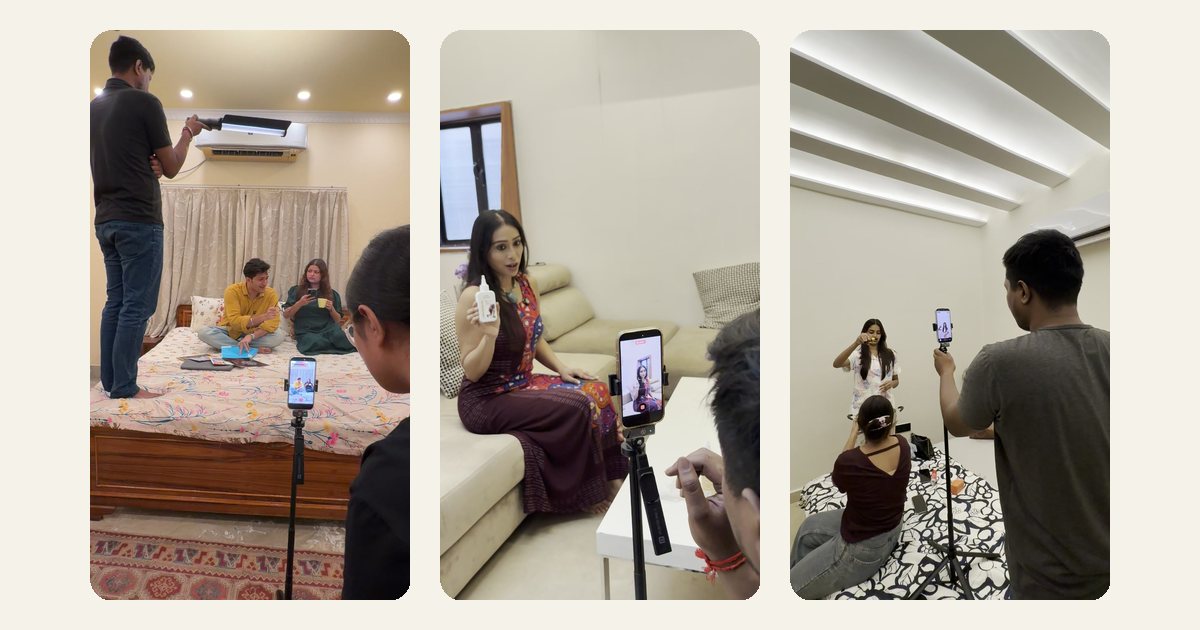
A brief that says "just be yourself and talk about why you love the product" is not a brief, it is an abdication. Brands that have run UGC for a year or more often discover that creator quality is not what separates a 2x ROAS ad from a 6x one; brief quality is. This playbook assumes you have already shipped at least two UGC campaigns. It skips the basics and goes straight into the structural and strategic gaps that consistently separate mediocre content from content that actually converts.
The frameworks below are drawn from the kind of iteration we see across brief-to-delivery cycles on Instagram Reels, YouTube Shorts, and Meta feed placements, the three formats where Indian D2C and FMCG brands currently spend the most on creator-led paid creative. Where ASCI guidelines intersect with brief design, those are flagged explicitly.
Separate the Narrative Frame from the Execution Variables
Most intermediate briefs collapse these two things into one "instructions" block. The result: creators follow the instructions but miss the emotional logic, and you get technically correct content that generates no response.
A mature brief has two clearly labelled sections:
- Narrative frame: the one-sentence emotional or situational premise the viewer should recognise themselves in. Example: "You are a working woman in Bengaluru who found a skincare routine that actually survived the office AC + pollution combo." This is not a script. It is the internal state the creator is inhabiting.
- Execution variables: hook format, product mention timing (typically within the first 4–6 seconds for paid Reels), required claim language, visual references, what NOT to say.
When creators have a clear narrative frame, they ad-lib naturally inside it. The result sounds authentic because it is, the creator is genuinely expressing something, just shaped by your premise.
Write the Hook as a Decision Tree, Not a Single Line
Experienced UGC teams know that a single mandated hook line creates two problems: creators who deliver it flatly, and a homogenous ad set that fatigues quickly. Instead, brief the hook as a decision tree with three branches:
- Pain-first hook: Opens by naming a specific frustration (example: "Mujhe pata hai Hyderabad ki garmi mein sunscreen lagana kitna irritating lagta hai"). Best for top-of-funnel cold audiences.
- Curiosity hook: Opens with a counter-intuitive statement or result (example: "Maine Rs.180 wali sunscreen aur Rs.1,400 wali sunscreen dono test kiye, result shocking tha"). Best for scroll-stopping on Reels explore.
- Social proof hook: Opens with a community signal (example: "Mere 3 colleagues ne poocha main kya use kar rahi hoon"). Best for retargeting warm audiences who recognise the category.
Brief all three. You get three distinct ads from the same shoot session, and you can run them against different audience segments from day one rather than waiting for one to fatigue before testing another.
Specify Claim Boundaries, Not Just Claims
This is where most brands are negligent, and where ASCI's Guidelines for Influencer Advertising in Digital Media (updated 2023) create real liability. ASCI requires that any claim made in a paid collab be substantiated. Vague brief language like "tell them it clears skin in 7 days" pushes a claim through the creator's mouth that your brand may not be able to substantiate.
A legally cleaner and creatively stronger approach: brief the claim ceiling, not the claim itself.
- Tell creators: "You can describe your personal experience. You cannot say 'clinically proven', '100% results', or give a specific timeframe you did not personally experience."
- Include one example of a permitted phrasing and one of a prohibited phrasing side by side. Creators appreciate the clarity; it removes their anxiety about crossing a line.
- Remind creators that ASCI requires a #ad or #sponsored label and that the label must be prominent, not buried in a hashtag stack. We brief creators to place it in the caption's first line, before the "more" fold on Instagram.
Brief language sample: "You can say 'mere baal pehle se zyada smooth lagte hain', that is your experience. You cannot say 'clinically proven to reduce breakage by 40%' unless we provide you the study reference."
Define the Audience Insight, Not Just the Target Demo
Telling a creator "our audience is women 25–35 in Tier cities across India" is not an insight, it is a segment definition. What a creator actually needs is a behavioural or emotional insight that the content can activate.
Contrast these two brief lines:
- Weak: "Our audience is busy working moms in Mumbai and Delhi."
- Strong: "Our audience has tried three different protein powders and abandoned all of them because the taste made morning routines feel like punishment. They want to be consistent but the product kept getting in the way."
The second version tells the creator what wound to press. They can improvise dialogue, camera placement, and emotional tone around a real psychological truth. We have found in our production work that briefs with a single precise audience insight produce first-take usable content at roughly twice the rate of demographic-only briefs, which matters when you are managing a batch of 8–10 creators and need to cut revision rounds.
Include a "Do Not Do" Section with Specific Examples
Generic briefs warn against "being overly salesy." That is useless. Advanced briefs list the exact mistakes that creep into creator content for this category, with concrete visual or verbal examples.
- For food/beverage brands: "Do not film in a kitchen that looks aspirational to the point of being unrelatable. A realistic home kitchen with normal clutter performs better for our segment. Avoid overly rehearsed ASMR-style reactions, our audience is sceptical of them."
- For skincare/haircare: "Do not do a before/after comparison unless the before footage is from genuine prior use and you disclose the timeframe. ASCI requires before/after ads to represent outcomes achievable by the typical user."
- For SaaS/ed-tech: "Do not promise income figures or career outcomes without a disclaimer. ASCI's advertising guidelines and the Consumer Protection Act both flag misleading earnings claims as actionable."
- Platform-specific: On Instagram Reels, avoid holding the phone horizontally, it signals low native quality. On YouTube Shorts, the first frame matters enormously; do not start with a black hold or a "Hi guys!" opener."
A precise "do not" list reduces rounds of revision by giving creators a self-checklist before they submit. Paying a creator Rs.8,000–15,000 for a video and then spending two revision rounds correcting preventable errors is expensive for both sides.
Brief the Product Integration Moment, Not Just the Product Mention
One of the most common failures in intermediate-level UGC is the "product insert" problem: the video is authentically engaging for 18 seconds, then the creator suddenly holds up the product and reads the pack copy. Viewers sense the seam and scroll.
The integration moment should be briefed as a narrative beat, a point in the story where the product appears as the logical resolution to a tension that was already established.
- Brief the tension first: "You have just described the 3 PM energy crash that makes the rest of the workday brutal."
- Then brief the product entrance: "Now, naturally, without breaking tone, you pull out the product as the thing that changed this pattern for you. The product is the answer to a question the viewer is already asking, not an interruption."
- Specify the product's on-screen duration and angle if it matters for your category (e.g., for a beverage, a natural sip shot works better than a label-forward hold).
Briefing the integration as a narrative beat rather than a checklist item is the single change that most consistently improves view-through rates on our paid Meta placements, particularly on 15–30 second Reels formats where every second of viewer attention is load-bearing.
Build Versioning Logic Into the Brief Itself
Brands running UGC at scale need creative volume, not just creative quality. A brief that only produces one usable video per creator is a structural inefficiency. Advanced briefs should include a versioning matrix that the creator can execute in a single shoot session.
- Hook swap: Shoot the same core content with two of the three hook variants from your decision tree.
- Language variant: If the creator is bilingual, which many creators in Bengaluru, Hyderabad, Chennai, and Mumbai are, brief one Hindi and one English version of the hook and outro. The body can remain in one language.
- Aspect ratio version: Brief a 9:16 Reels version and a 1:1 feed-post version. The 1:1 version simply reframes; it does not require a separate shoot if the creator knows to leave headroom in the frame.
- Outro swap: Two different call-to-action closings, one driving to the product page, one driving to an offer or trial. This lets you test CTA performance without commissioning fresh content.
A single creator session at Rs.10,000–18,000 can yield 6–8 distinct ad variations if the brief is architected for versioning from the start. That is the leverage point, not finding cheaper creators.
If you are ready to move beyond single-campaign UGC and want briefs that are engineered for paid performance from the first frame, the team at The UGC Agency works with brands on brief architecture alongside full production. Book a consultation to see how we structure briefs for Indian D2C and FMCG accounts running at scale.