Every year, the list of 'what works on Meta' evolves. Creative formats that dominated two years ago are now saturated. New behaviours emerge. The algorithm changes how it rewards different creative signals. This guide is a practical snapshot of what creative approaches are producing the strongest results for Indian D2C brands on Meta in 2026, based on patterns across the campaigns we are running and the data we are seeing across categories.
The Dominant Format: Short-Form UGC on Reels Placement
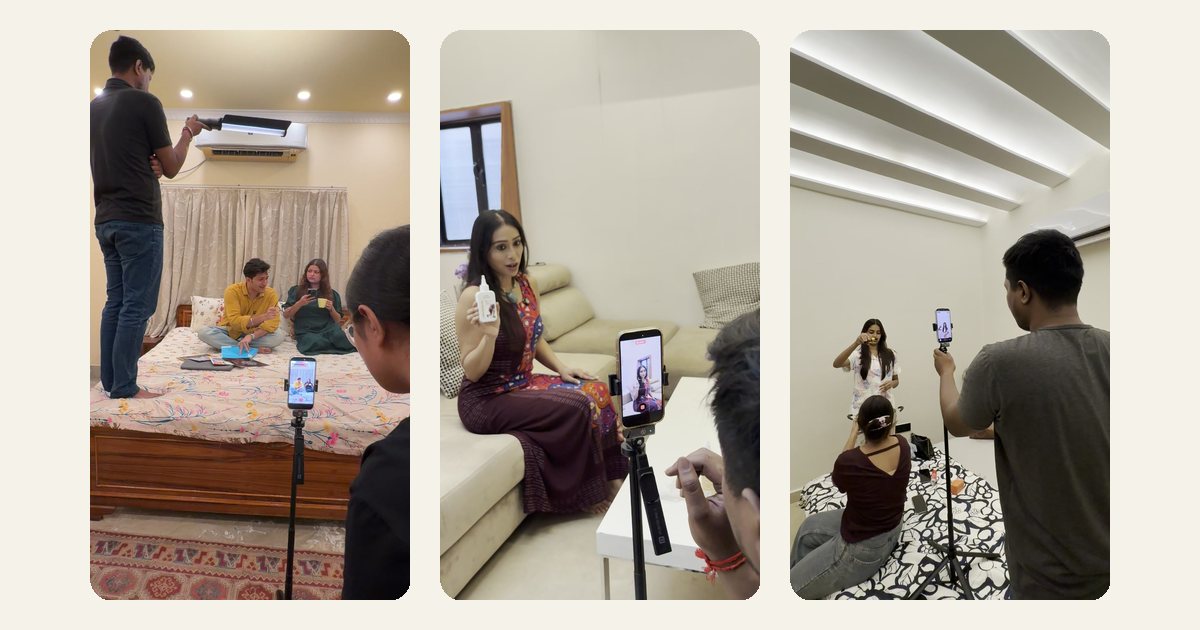
Reels placement has cemented its position as the highest-volume, highest-performing ad placement on Meta for most Indian D2C categories in 2026. The creative format that consistently outperforms everything else on Reels: 20 to 35 second UGC-style videos with a problem-identification hook in the first three seconds, a brief demonstration or proof point in the middle, and a friction-reducing CTA at the end. This format has been working for two years, but the execution bar has risen: audiences have become more discerning, hooks that felt fresh in 2023 feel formulaic now, and brands that have not evolved their hook approach are seeing hook rates decline.
The freshest hooks in 2026 are the ones that feel genuinely spontaneous rather than scripted: a creator reacting to a result, a creator discovering a product feature they did not expect, or a creator starting mid-thought as if the video is catching a conversation in progress rather than starting from a prepared opening.
What Has Replaced the 'Talking Head Product Review'
The straightforward talking head product review ('Hi, I have been using this product for a month and here is what I think') was the workhorse of UGC creative for several years. It is still a functional format but it is significantly saturated on Meta placements. Audiences have seen thousands of these and they require a much stronger hook to stop the scroll than they did previously.
The formats that are replacing and outperforming the standard talking head review:
- Point-of-view (POV) format: Creator films from a first-person perspective, showing the product being used rather than talking about it. Immersive, different visual language, and performs strongly for categories with visual proof points.
- Dual-creator format: Two creators reacting to the product together, creating a natural conversation rather than a monologue. More expensive to produce but generates stronger watch-through rates because the conversational dynamic creates anticipation.
- Reaction-forward format: The emotional reaction comes first, then the explanation. A creator looking at a result with a genuine expression before explaining what caused it creates the curiosity gap that makes people watch to the end.
The Rise of Value-Oriented Messaging
Indian consumers in 2025-26 are buying in a context of cost consciousness, and creative that addresses value explicitly is outperforming pure aspiration creative across most categories. This does not mean leading with discounts or deals (which trains audiences to wait for promotions). It means framing value authentically: 'I was spending X on this category every month and this replaced it for less' or 'I was hesitant about the price but the quality surprised me.' Genuine value statements from real creators resonate in a way that brand-claimed value propositions do not.
Meta Advantage+ Creative: Working With the Algorithm
Advantage+ Creative (Meta's automated creative optimisation) is now a significant factor in how creative performs at scale. The best practice in 2026 is to provide Meta with four to six creative variants per ad set and let Advantage+ Creative optimise delivery across them rather than manually managing creative rotation. This approach consistently outperforms manual creative management for brands above 5 lakh monthly spend. The implication for creative strategy: produce variants rather than single assets. Brief creators for two or three hook variations on the same concept rather than one definitive version.
Audio-Off Optimisation Is Non-Negotiable
Industry data consistently shows that 60 to 80 percent of Meta video ads are watched with the sound off, at least initially. Creatives that rely on audio to communicate the core message are invisible to this audience. Every UGC creative in 2026 should be built to communicate its core hook and value proposition through the first five seconds of visual and on-screen text, with the audio enhancing rather than being essential. Captions are the minimum. Text overlays on the hook and key messages are better.
Takeaway
The best Meta ad creatives in 2026 are UGC-led, Reels-optimised, visually communicative even without sound, value-oriented in their messaging, and produced in variants that let the algorithm learn across multiple angles. Brands that are still running the standard talking head review as their primary format have not evolved fast enough to keep pace with audience expectations. If you want a creative audit of your current Meta strategy and a brief plan for 2026, book a strategy call and we will tell you exactly what to change.