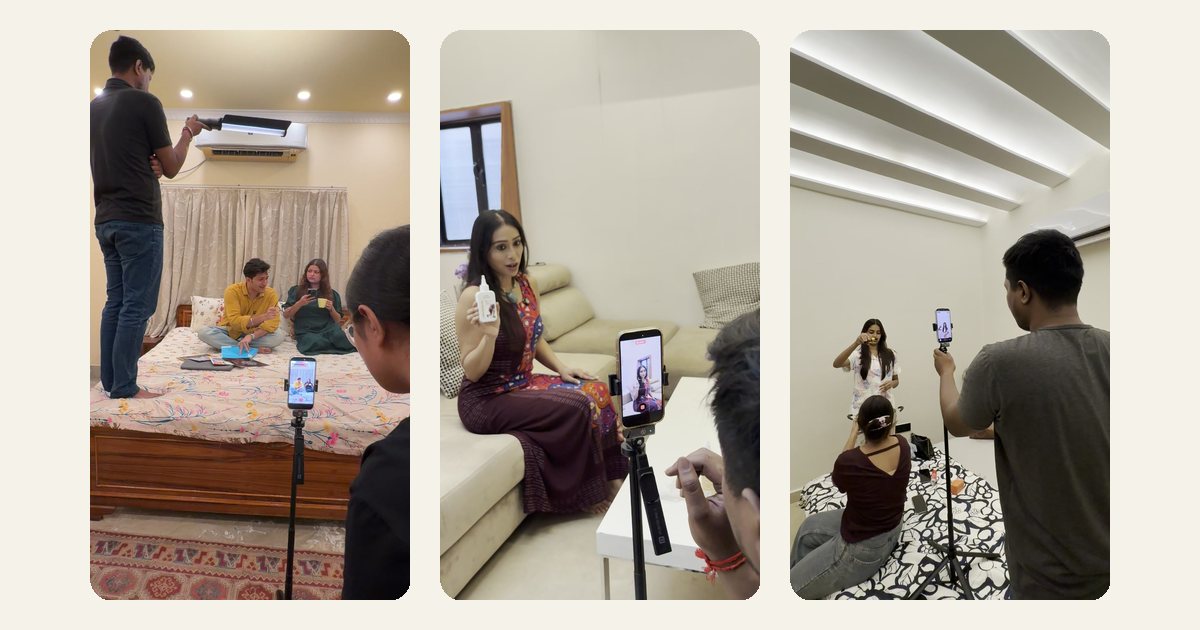
Indian consumers bring a specific set of expectations, values, and scepticisms to their online purchases. A UGC creative strategy built for a US brand and transplanted into an Indian campaign will underperform—not because UGC does not work, but because the triggers, language, and reference points are wrong. The following seven strategies are drawn from real campaign experience with Indian D2C brands and are specifically calibrated for how Indian buyers scroll, evaluate, and decide.
1. Open with a Relatable Pain Point in Local Language
The first three seconds determine whether someone watches or scrolls. For Indian audiences, a hook that opens in Hindi or a regional language—with a specific, relatable frustration—out-performs English openers in almost every category outside of premium B2B. “Bhai, mere baal itne dry ho gaye the...” is more stopping than “Struggling with dry hair?” The specificity of the frustration matters as much as the language choice. Vague pain points do not hold attention.
2. Use the ‘Before the Product Existed’ Frame
One of the most consistently effective UGC structures in India is what might be called the “before the product existed” frame: the creator describes their life or routine before discovering the product, then shows what changed. This works particularly well in health, beauty, and home categories where the transformation is tangible. It also works because it positions the product as a discovery rather than a purchase—viewers feel they are learning something, which lowers ad-aversion.
3. Address Price Scepticism Directly
Indian consumers are value-conscious and often sceptical of premium pricing without justification. A UGC creator who acknowledges the price point—“Yes, it’s more expensive than what I was using before, but here is why I think it’s worth it”—converts better than one who ignores the elephant in the room. This honesty signals authenticity and directly handles the most common objection in the consideration phase.
4. Show the Product in a Recognisable Indian Context
Where the product appears in the video matters. A kitchen counter with recognisable Indian vessels, a bathroom with familiar product placements, a mother feeding a toddler in a recognisable home setting—these contextual signals tell viewers “this is for people like me.” Generic white-background shots or Western-looking interiors create a subtle distance between the viewer and the product, reducing purchase confidence.
5. Include One Specific, Measurable Claim
Vague claims (“my skin feels amazing”) are dismissed. Specific, measurable observations (“my skin was noticeably less oily within ten days”) are remembered and acted on. Brief creators to include one concrete, time-bound or quantity-specific observation. It does not need to be a clinical claim—it just needs to be specific enough to feel true rather than scripted.
6. Feature Multiple Creator Demographics for the Same Product
Indian consumers self-identify across many dimensions—language, region, skin tone, age, lifestyle. A brand selling a face serum should have UGC from a young woman in her twenties, a woman in her thirties managing combination skin, and ideally a male creator if the product has any male buyer base. This is not tokenism—it is the practical recognition that purchase confidence is highest when the buyer sees someone who looks and sounds like them reporting an outcome.
7. End with a Soft Call to Action, Not a Hard Sell
Indian consumers respond poorly to high-pressure sales language in video ads. A creator ending with “I would genuinely recommend giving this a try if you’ve been dealing with this problem” outperforms “Go buy this now, link in bio!” in most D2C categories. The soft recommendation respects the viewer’s autonomy and feels more authentic—which is precisely what makes it more persuasive.
Takeaway
High-performance UGC for Indian brands is not generic UGC with Indian faces—it is content built around Indian buyer psychology, language preferences, price sensitivity, and cultural context. Each of these seven strategies is testable independently. Run them systematically and let the data tell you which combinations work best for your specific audience.
Want to build a UGC creative programme around these strategies? Book a strategy call and let’s design a brief framework for your brand.