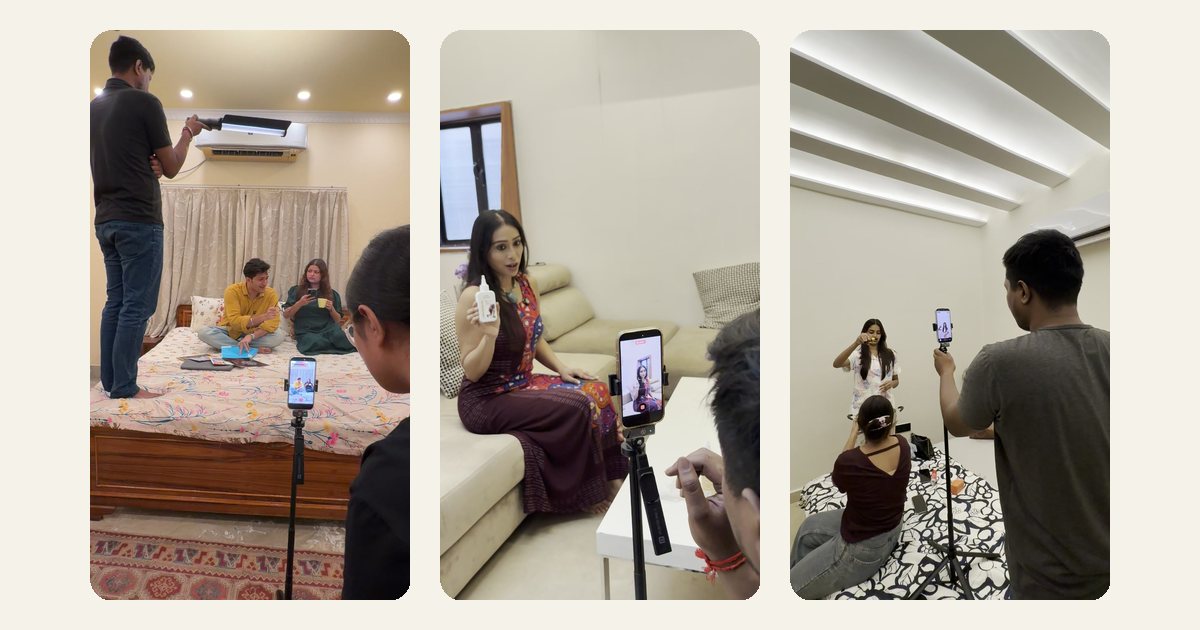
Producing UGC and running UGC that converts are two different things. The gap between them is usually strategic, not creative — it's about how the content is structured, where it's placed, and how systematically it's tested. Here are seven approaches that consistently move the needle for Indian D2C brands.
1. Lead With the Problem, Not the Product
Indian consumers are ad-literate. Opening a UGC video with the product name or logo signals "ad" immediately and loses attention. The most effective approach opens with a problem the viewer recognises in their own life — a skin concern, a storage challenge, a sleep issue — before the product is ever mentioned. This pattern works especially well on Meta and YouTube where the first two seconds determine whether a viewer keeps watching.
2. Match Creator Language to Your Target Buyer
Language is a trust signal in India in a way it isn't in many other markets. A creator speaking in the same register — Hindi, regional language, or code-switched Hinglish — as your core buyer produces a subconscious familiarity that brand-voice narration can't replicate. If your customer acquisition is concentrated in Tier cities across India, a creator who speaks Hindi naturally will outperform an English-language creator regardless of script quality.
3. Use Specificity as a Conversion Tool
Vague claims don't convert. "This product changed my life" is instantly discounted. "I've been using this for 21 days and my skin texture has noticeably improved" gives the viewer a time frame and a specific outcome to evaluate. Brief creators to speak with genuine specificity — even if the product is new to them, encourage them to engage with it for several days before filming and to describe their actual experience rather than reading from a generalised script.
4. Build Objection-Handling into the Script Structure
Most purchase decisions stall on a specific objection: price, ingredient concern, sizing uncertainty, return policy anxiety. The most conversion-effective UGC addresses the most common objection directly, mid-video. This structure — problem, product introduction, common objection acknowledged and answered, outcome — mimics the shape of a good sales conversation and moves viewers past the hesitation that stops them from buying.
5. Produce Multiple Hooks for the Same Core Creative
Rather than producing ten completely different videos, produce three to four core narratives with two or three hook variations each. This gives media buyers testable creative variety without requiring proportionally more production investment. The hook — the first two seconds — is often what determines performance, and a different hook on the same underlying content can produce dramatically different click-through rates.
6. Place UGC at the Cart Abandonment Stage
Most UGC strategy focuses on top-of-funnel acquisition. But UGC embedded in cart abandonment flows — WhatsApp re-engagement messages, email sequences, or retargeting ads — is often even more effective because the viewer has already expressed intent. At this stage, a short testimonial-style UGC clip that addresses a likely hesitation ("I was worried about the smell, but it's actually really light") can be the push that converts a warm lead.
7. Test Formats Systematically, Not Randomly
Talking-head, voiceover-with-product-footage, unboxing, day-in-the-life, before-and-after — each format has different emotional mechanics and performs differently by category. Don't guess which format is right for your product. Build a simple testing grid: format on one axis, hook on another, and track performance systematically. This turns UGC production from creative guesswork into a data-informed process.
Takeaway
Conversion-focused UGC is built on structure, specificity, and systematic testing — not on the hope that authentic content will automatically perform. The brands that win with UGC in India are the ones who treat it as a performance marketing discipline. Book a strategy call to build a conversion-focused UGC system for your brand.