Creative fatigue is one of the most misdiagnosed problems in performance marketing. A campaign that delivered excellent cost-per-lead numbers for six weeks starts deteriorating — CPL climbs, frequency goes up, ROAS falls — and the instinct is to change the audience, revisit the offer, or blame the platform. In most cases, the real problem is simpler: your audience has seen your ad enough times that it no longer registers. The fix is not a new targeting strategy. It's new creative.
How Creative Fatigue Actually Works
Meta and Google both track a metric called frequency — the average number of times a single user has seen your ad in a given period. When frequency climbs above 3–4 in a short window, performance typically starts to degrade. The user has mentally categorised your creative and stops engaging with it consciously. Even if they liked your product the first time, the twelfth impression of the same video generates the same response as background noise.
The problem compounds because platforms interpret declining engagement as a signal to reduce distribution efficiency — meaning you start paying more to reach fewer people, which accelerates the performance decline. Creative fatigue is not a gradual slope; it tends to hit a cliff.
Why Most Brands Can't Solve It with Studio Content
The obvious solution is to keep producing new creatives. The problem is that traditional creative production — shoot planning, studio booking, art direction, post-production — takes 3–6 weeks and costs ₹1–3 lakh per video for a brand doing things properly. By the time the replacement creative is ready, the original has already fatigued out and CPL has been elevated for a month.
Even brands with reasonable production budgets typically end up rotating 3–5 creatives across a campaign. That's not enough. A high-performing Meta campaign for a D2C brand needs a library of 15–25 active creative variants to meaningfully suppress fatigue — different hooks, different formats, different creators, different angles on the same product benefit.
What a UGC Pipeline Solves
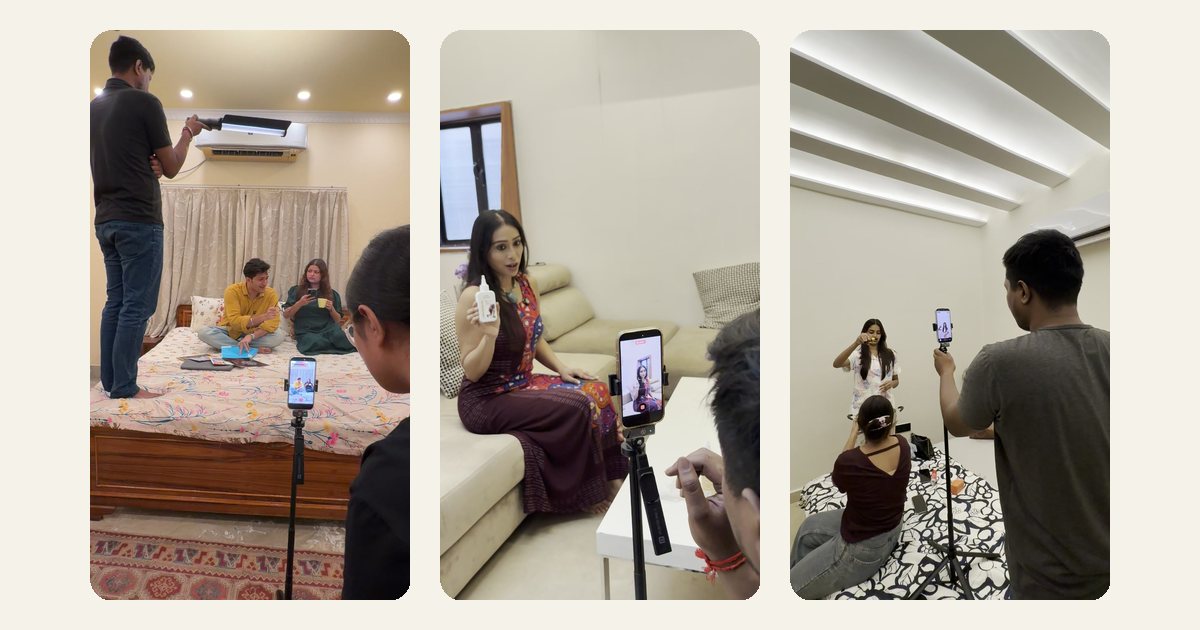
A well-run UGC content pipeline produces 18 or more videos per month — enough to continuously introduce fresh creative into active campaigns and retire fatigued assets without ever depleting your library. Each video comes from a different creator with a different face, location, speaking style, and use-case scenario. To a Meta user, these are not 'the same ad again' — they are different people talking about a product they love.
The practical result is that frequency can be managed at the creative level rather than the audience level. Instead of shrinking your target audience to reduce repeat exposure, you keep your audience broad and rotate creative fast enough that individual users rarely see the same asset more than twice.
Brands we work with that maintain a consistent UGC pipeline typically see:
- CPL stability over longer campaign durations (8–12 weeks vs. the typical 3–4 week cliff)
- Ability to scale spend without the proportional CPL increase that fatigued creative causes
- A library of top-performers that can be recycled 4–6 months later when audience memory has reset
Building the Rotation System
Volume alone is not enough — you need a system for identifying fatigue early and rotating proactively. The signals to watch are: frequency crossing 3.5 in a 7-day window, CTR dropping more than 25% from the creative's peak, and CPL climbing more than 20% week-over-week without changes to bidding or audience.
When any of these signals appear, the response should be automatic: pull the fatigued creative, introduce two or three new variants from your library, and let the algorithm reoptimise. This requires having the library ready — which is exactly what a UGC pipeline is designed to provide.
It also helps to categorise your creative library by hook type (problem-led, testimonial, demo, transformation, comparison) so you can ensure variety rather than rotating between five videos that all open the same way.
The Cost Arithmetic
The economics of UGC vs. studio creative look different when you account for fatigue. A ₹2 lakh studio video that fatigues in four weeks has an effective cost-per-week of ₹50,000. A UGC content package that delivers 18 videos for a similar budget gives you 18 weeks of fatigue-resistant creative — and each individual asset costs roughly ₹11,000. Even accounting for the fact that not every UGC video will be a top performer, the fatigue economics strongly favour volume over polish.
Takeaway
Creative fatigue is a solvable problem — but it requires accepting that the solution is a pipeline, not a production. Brands that invest in high-volume UGC content systematically outperform those chasing the perfect single creative, because the market rewards freshness and relevance over production value.
To build a UGC pipeline that keeps your CPL stable as you scale, book a strategy call and we'll map out a content volume plan for your brand.