SaaS is a trust problem before it is a product problem. When a finance team in Pune is deciding between two invoicing tools, or an HR manager in Bengaluru is shortlisting HRMS platforms, neither of them wants to read feature grids, they want to hear from someone who has already lived with the software. That is precisely the gap that user-generated content fills for SaaS brands, and it requires a fundamentally different production approach than UGC for D2C or FMCG.
Here is how we actually build and execute UGC programmes for SaaS clients at The UGC Agency, from brief to final cut, with the specific decisions that make these videos convert rather than just accumulate views.
Why SaaS UGC Lives or Dies on Creator Selection
For a skincare brand, almost any creator with the right skin concern and a phone can deliver a credible testimonial. SaaS is different. The creator must be someone who would plausibly use the product, and can speak to its specifics without sounding scripted. When we run creator briefs for a project management or CRM SaaS targeting Indian SMBs, we filter specifically for:
- Professional role relevance: founders, operations leads, agency owners, finance managers, personas who match the actual buyer. LinkedIn verification or a brief on-camera intro confirming their role adds credibility instantly.
- Regional familiarity: we deliberately cast across Bengaluru, Mumbai, Delhi NCR, and emerging Tier-2 markets like Indore or Coimbatore, because Indian SaaS buyers trust peer voices from their own context more than a metro-generic face.
- Language capability: English-language SaaS UGC performs well for the startup and enterprise segment, but Hindi and regional-language cuts, Tamil, Telugu, Marathi, open up the SMB and semi-urban segment that most SaaS brands are aggressively chasing right now.
We typically run a 20–30 minute discovery call with each creator before the shoot to surface authentic pain points they genuinely relate to. That raw material is what the brief is built from, not the other way around.
The Brief Architecture for SaaS UGC
A SaaS UGC brief is longer and more structured than what we send for a snack or beauty brand, because the creator needs to understand the product well enough to speak naturally. The sections we consistently include:
- The "before" state: what workflow problem were they solving before the product? We ask creators to describe it in their own words, not from our brief, and we coach them to be specific (e.g., "reconciling GST entries in three different Excel sheets at month-end" rather than "managing finances was painful").
- One or two concrete features, not a feature list: we pick the one or two capabilities most relevant to the ad set's objective. If it is a retargeting video, we might focus on a specific integration or report. If it is a top-of-funnel video, the hook is the broader time-saving or cost-saving outcome.
- Social proof elements: we prompt creators to mention tenure ("I have been using this for about eight months"), team size where relevant, or a result they can genuinely claim. ASCI guidelines require that any quantified claim, "saved 4 hours a week", "reduced errors by 40%", must be an honest representation. We include a reminder in every brief that creators should only quote figures they can actually substantiate, and we review scripts before shoot if specific numbers are mentioned.
- A natural CTA: for SaaS, free-trial or demo CTAs outperform discount-driven ones. We brief creators to end with a prompt like "if your team is dealing with this, the free trial is genuinely worth trying" rather than "use my code for 20% off", the latter signals consumer product and undercuts the professional framing.
Formats That Work for Indian SaaS Campaigns
We have tested several content formats with SaaS clients across Instagram Reels, YouTube pre-roll, and LinkedIn video ads. The formats that consistently perform well in our production work:
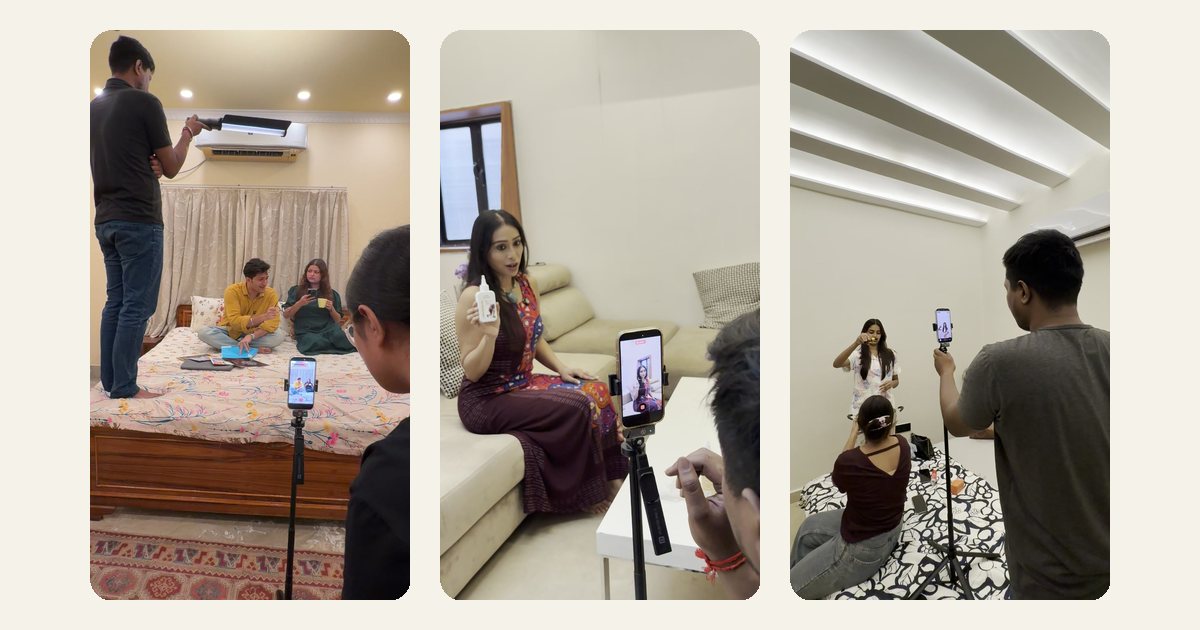
- Problem-first talking-head (45–75 seconds): the creator opens by describing a recognisable operational frustration, a missed deadline, a GST filing crunch, a team scattered across cities, before introducing the product as the resolution. Shot at a desk or home-office setting, not a studio, so it reads as genuine peer content.
- Screen-share walkthrough with voiceover: particularly effective for retargeting campaigns where the audience already knows the brand name. The creator records their actual use of the product, navigating a dashboard, running a report, while narrating what they are doing. Production cost is low, and the specificity builds trust rapidly.
- Team adoption story (90 seconds–2 minutes): a slightly longer format where the creator describes rolling out the tool to a team of five or ten people, covering initial resistance and eventual adoption. This format works well as YouTube pre-roll and in LinkedIn sponsored content for mid-market SaaS targeting operations or IT decision-makers.
- Short-form objection-handler (15–30 seconds): a single-idea video that addresses one common hesitation, "you can set it up in a day, you don't need a developer" or "yes, it handles Indian GST reporting, that was my main concern too." These pair effectively with retargeting audiences who have visited a pricing page but not converted.
LinkedIn video ads deserve specific mention. For B2B SaaS with deal sizes above Rs.50,000 annually, LinkedIn's targeting precision, by company size, seniority, and function, makes it cost-effective despite higher CPMs (typically Rs.300–600 per thousand impressions in India versus Rs.60–120 on Meta). We produce slightly more formal creator videos for LinkedIn: cleaner backgrounds, professional attire, slower pacing. The same creator may shoot two slightly different versions, one for Instagram, one for LinkedIn, in a single session.
Localisation at Scale Without Losing Authenticity
One mistake we see SaaS brands make is treating localisation as dubbing, they shoot a single English video and add a Hindi voiceover. The result feels dubbed because it is dubbed, and Indian audiences clock that immediately, especially in the SMB segment where trust is everything.
Our approach is to cast separate creators for each language version and give them the same brief framework but let them construct their own narrative in their language. A Tamil-speaking founder in Chennai will frame a payroll software problem differently from a Hindi-speaking business owner in Jaipur, and both framings are more credible to their respective audiences than a translated script.
For SaaS clients on tighter production budgets, say, a Series A startup allocating Rs.3–4 lakh per quarter to UGC, we prioritise the two or three highest-value language markets based on their existing user base geography, then expand. Most Indian SaaS companies find that Hindi-English (mixed or separate) plus one South Indian language covers the majority of their growth opportunity without requiring a full-scale multilingual rollout from day one.
Compliance and ASCI Considerations for SaaS UGC
ASCI's influencer disclosure guidelines apply equally to paid SaaS UGC. Any creator who has received payment, software access, or any form of consideration must label the content with a visible disclosure, "Paid Partnership" on Instagram or "Sponsored" on LinkedIn. We make this non-negotiable in our creator contracts, and we flag it in the brief.
For SaaS specifically, there are two additional areas that require care:
- Feature claims: if a creator says the software does something, automated compliance reports, real-time inventory sync, the feature must actually work as described. We cross-check specific feature claims with the client's product team before the brief is finalised.
- Results and ROI claims: "cut my reporting time by half" is a personal testimonial and acceptable if genuine. "This software will save every business 10 hours a week" is a generalised performance claim and crosses into territory ASCI takes seriously. We coach creators to keep outcomes personal and specific to their context.
A creator saying "I used to spend three hours every Monday on this; now it takes thirty minutes" is a more defensible and more believable claim than any brand-authored statistic about productivity gains.
Measuring UGC Performance for SaaS Funnels
SaaS UGC does not always convert on first touch, and the measurement framework needs to reflect that. The metrics we track for clients across a 90-day campaign window:
- View-through rate and video completion rate: for top-of-funnel awareness. If completion drops sharply before 15 seconds, the hook needs reworking, usually the creator is taking too long to state the problem.
- Click-to-free-trial rate: the primary conversion event for most Indian SaaS brands. We benchmark this separately for warm retargeting audiences versus cold prospecting audiences, because the gap is usually significant and conflating them masks what is actually working.
- Assisted conversions: SaaS buyers research across multiple touchpoints. A UGC video on Instagram may not be the last click, but it is often a material step in the path. We ask clients to run a 7-day click and 1-day view attribution window initially, then adjust based on their actual sales cycle length.
- Quality of sign-ups: for SaaS clients with sales-assisted onboarding, we track whether UGC-sourced sign-ups convert to paid at comparable rates to other channels. In our experience, creator-led social proof tends to bring in leads with higher initial intent, because the creator has already handled a layer of objection-handling before the user arrives at the trial page.
If you are running a SaaS growth programme and want to see how creator-driven content would fit your funnel, including realistic budgets for multilingual production and platform-specific format choices, our team is happy to walk through the specifics. Book a consultation and we can look at your current acquisition mix and where UGC would have the highest leverage.