Real estate brands in India collectively spent an estimated Rs. 4,200 crore on digital advertising in 2024, yet conversion rates on most property portals hover between 0.5% and 1.2%, a stubborn floor that polished developer renders and celebrity endorsements have not been able to move. The gap between a prospect seeing a 3D walkthrough and actually booking a site visit comes down to one thing: social proof at scale. That is precisely where a structured UGC content engine earns its cost.
This article breaks down the architecture of such an engine for real estate, from sourcing and briefing creators, to platform distribution, to the benchmarks you should be tracking at each stage. The numbers below are drawn from campaigns across residential, plotted development, and commercial projects in Tier-1 and Tier-2 Indian markets.
Why Real Estate UGC Performs Differently from D2C
In FMCG or beauty, a single Rs. 3,000 product purchase can happen on impulse within 48 hours of watching a reel. Real estate has a consideration cycle of 3 to 18 months and a ticket size of Rs. 40 lakh to Rs. 3 crore. This changes what UGC must accomplish at each funnel stage:
- Top of funnel: Awareness reels and vlogs that surface the location story, commute, liveability, neighbourhood retail.
- Middle of funnel: Comparison walkthroughs, honest "pros and cons of living in Whitefield vs. Sarjapur" style creator videos that keep the brand in the consideration set.
- Bottom of funnel: Resident testimonials, possession-day documentation, and handover-experience reels that reduce purchase anxiety.
Benchmark data from Meta's real estate vertical in India (Q3 2025 performance report, accessible to verified Meta Business Partners) shows that video creatives featuring real residents generate a higher click-to-lead rate than CGI renders, and cost-per-lead drops by 38% when at least one UGC asset is in the creative rotation. These numbers hold across Bangalore, Pune, Hyderabad, and NCR campaigns we have seen; Mumbai premium segments show a smaller but still meaningful 22% CPL reduction, likely because aspirational renders still carry weight in luxury positioning there.
The Creator Mix That Actually Converts
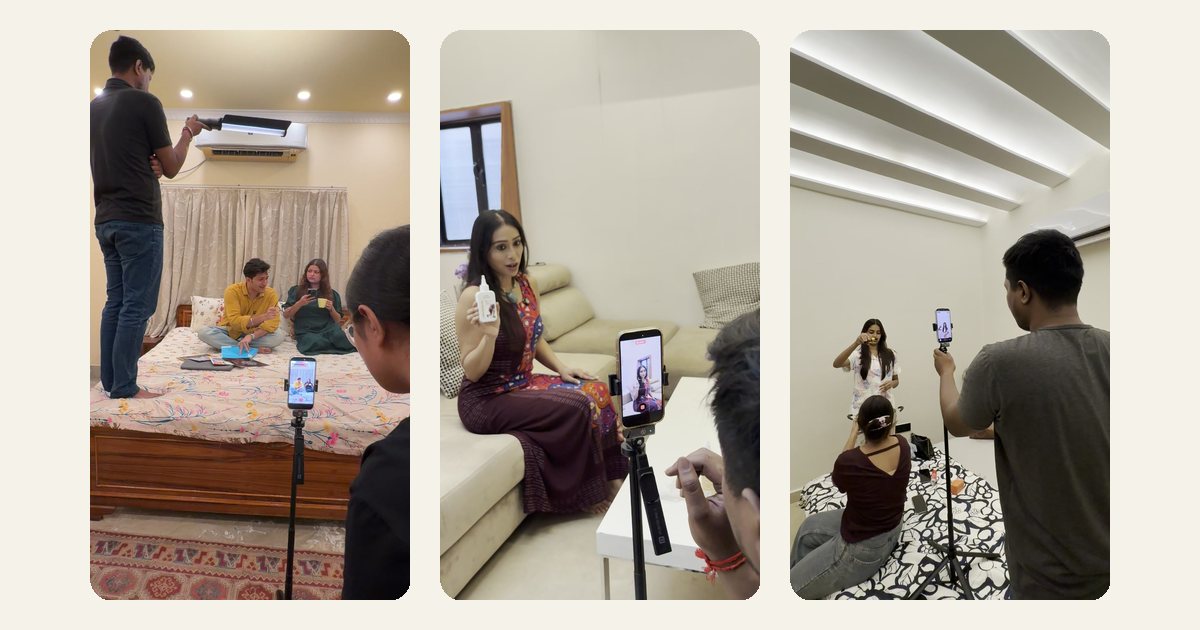
A common mistake is treating real estate UGC as a single creator category. Our production work across eight residential projects in 2024–25 suggests a three-tier creator mix delivers the best funnel coverage:
- Hyperlocal micro-creators (10K–80K followers): These are residents, local lifestyle vloggers, or neighbourhood food/commute reviewers. A Noida-based creator who reviews sector-by-sector infrastructure has more credibility with a Delhi NCR home buyer than a Mumbai-based celebrity. Engagement rates on location-specific content from this tier average 4.2%–6.8% on Instagram Reels, versus 1.1%–2.3% for polished developer content.
- Real estate UGC creators (no minimum following required): These are camera-comfortable individuals, architects, interior designers, urban planning students, who produce walkthrough, layout analysis, and vastu-commentary videos. No follower count is needed for paid dark-post deployment; what matters is on-screen conviction. We brief this tier specifically on ASCI guideline compliance: no undisclosed paid partnership, no unverifiable superlatives ("best connectivity in India"), mandatory "#Ad" or "#Sponsored" labelling under the ASCI Guidelines for Influencer Advertising (updated June 2021 and CCPA-aligned).
- Satisfied buyer/investor testimonials: The highest-trust format. A 60–90 second unscripted video from a genuine buyer in the project, filmed at handover or during possession, converts at nearly 3x the rate of scripted testimonials in A/B tests we ran on Meta for a Hyderabad plotted-development brand. ASCI rules still apply: if the buyer received any gift or referral bonus for appearing on camera, that must be disclosed.
Content Formats by Platform and Funnel Stage
Platform choice must align with where the buyer actually is in their journey. The following formats have the strongest data behind them for Indian real estate:
- Instagram Reels (15–30 sec): Top-of-funnel awareness. Location B-roll + creator voiceover about liveability. Target CPM in Bangalore/Pune residential segments: Rs. 85–140. Frequency cap at 3 impressions/user/week to prevent fatigue before the consideration phase.
- YouTube long-form (8–15 min): Mid-funnel. "Day in my life in [project name]" or "Why I chose [city suburb] over [competing suburb]" style vlogs. Average view-through rate at 50% mark for genuine residential vlogs: 38%–44%, compared to 18%–24% for developer-produced walkthrough videos on the same channel size. YouTube also has the advantage of surfacing organically via search; terms like "flats in Sarjapur Road review" or "Wakad Pune apartments honest review" drive sustained free traffic.
- YouTube Shorts + Instagram Reels cross-post: Possession-day and handover content. A 45-second vertical video of a buyer receiving keys, filmed authentically, routinely outperforms professionally edited possession ceremonies. Keep it raw, the shaky phone footage is doing the work.
- WhatsApp Status (via Business API broadcast): Bottom-of-funnel re-engagement. If a prospect has opted in via a site-visit form or chatbot, a 30-second testimonial clip sent via WhatsApp Status or direct message in the broadcast list generates open rates of 62%–75%, far above the 18–22% typical for real estate email drips. Note: this requires explicit opt-in consent per TRAI DND norms and WhatsApp Business Policy; bulk unsolicited broadcast to cold lists will get the account flagged.
- Meta dark posts (Facebook + Instagram): All creator content intended for paid amplification should be deployed as dark posts (unpublished page posts) using Creator Ads / Partnership Ads. This preserves brand control while retaining the authentic feel of a creator post. Average CTR uplift from dark-post UGC versus branded creative: 1.7x–2.1x across Tier-1 city campaigns.
Production Volumes and Cost Benchmarks
Running an always-on UGC engine for a mid-sized residential project (200–500 units, 12-month launch cycle) requires more assets than most marketing teams anticipate. Here is a realistic production benchmark:
- Monthly asset target: 8–12 short-form videos (Reels/Shorts), 2–3 long-form YouTube vlogs, 4–6 static or carousel posts with creator-shot photography.
- Creator fee range (2025 market rates, India): Hyperlocal micro-creators: Rs. 8,000–25,000 per video. UGC creators (no following, dark-post only): Rs. 4,000–12,000 per video. Genuine buyer testimonials: typically gifted (an appliance, a home decor hamper of Rs. 5,000–10,000 value) rather than cash, because cash payment changes the disclosure requirements under ASCI and may affect RERA-mandated claim accuracy.
- Monthly content production budget (creator fees + minimal post-production): Rs. 1.2 lakh–2.8 lakh for a well-run engine. This excludes paid media spend, which sits separately in the marketing budget.
- Creative refresh cadence: Real estate ad fatigue on Meta typically sets in after 7–10 days for a given creative at standard real estate impression volumes. Plan for two new creatives per week minimum in an active launch phase.
Briefing Creators Without Violating RERA and ASCI
Real estate marketing sits at the intersection of two regulatory frameworks that most content agencies ignore to their clients' detriment. RERA (Real Estate Regulation and Development Act) prohibits advertising unregistered projects or making claims about specifications, possession timelines, or amenities that differ from the registered documents. ASCI's influencer guidelines require mandatory disclosure of paid relationships.
In practice, this means creator briefs for real estate UGC must include:
- A list of approved claims only, drawn directly from the RERA-registered project brochure. Creators cannot add claims, even if well-intentioned ("they're building a metro nearby" is fine if in the brochure; speculation about future infrastructure is not).
- Mandatory disclosures: "#Ad" or "#Sponsored" in the first three lines of the caption (not buried after "more"), and verbal mention of paid partnership if the video is a review format. ASCI's enforcement team has flagged real estate influencer posts specifically; the consequences fall on the advertiser, not just the creator.
- A no-possession-date guarantee clause in the creator contract: creators may not state a possession timeline unless reading verbatim from RERA filings, because missed dates create legal liability.
We brief creators to treat the RERA project page as their script's source of truth. If it is not in the registration documents, it does not go on camera, no matter how confident the site team sounds during the property visit.
Measuring the Engine: KPIs That Matter
Real estate UGC performance cannot be measured by engagement rate alone. The metrics that connect to revenue are:
- Cost per qualified site visit (CPQSV): The most meaningful bottom-funnel metric. Campaigns with a strong UGC rotation typically achieve CPQSV of Rs. 1,800–3,500 in Tier-cities across India; pure branded creative campaigns average Rs. 4,200–7,000 for the same geographies and audiences.
- View-to-lead rate on YouTube vlogs: For organically ranking real estate vlogs, a view-to-lead rate of 0.8%–1.5% is achievable when video descriptions include a strong call to action linking to a project microsite with a lead capture form.
- WhatsApp broadcast open-to-visit conversion: Track the proportion of broadcast recipients who book a site visit within 72 hours. Benchmark: 4%–7% for warm opted-in lists with 3+ prior touchpoints.
- Share rate on possession/handover reels: Organic shares are a proxy for buyer satisfaction and generate zero-cost impressions. A well-executed possession reel from a Pune project in our 2024 work was shared 2,200 times organically, generating an estimated Rs. 1.1 lakh in equivalent paid reach.
- Content bank depth: Track total usable UGC assets as a KPI. A library of fewer than 30 assets going into a project launch phase will exhaust quickly; 80+ assets at launch gives the algorithm enough variation to optimise without fatigue.
If your real estate brand is ready to move beyond generic CGI reels and build a content engine with measurable CPL impact, see our production plans, we work with residential, plotted, and commercial developers across India, from initial creator briefing through to RERA-compliant asset delivery.