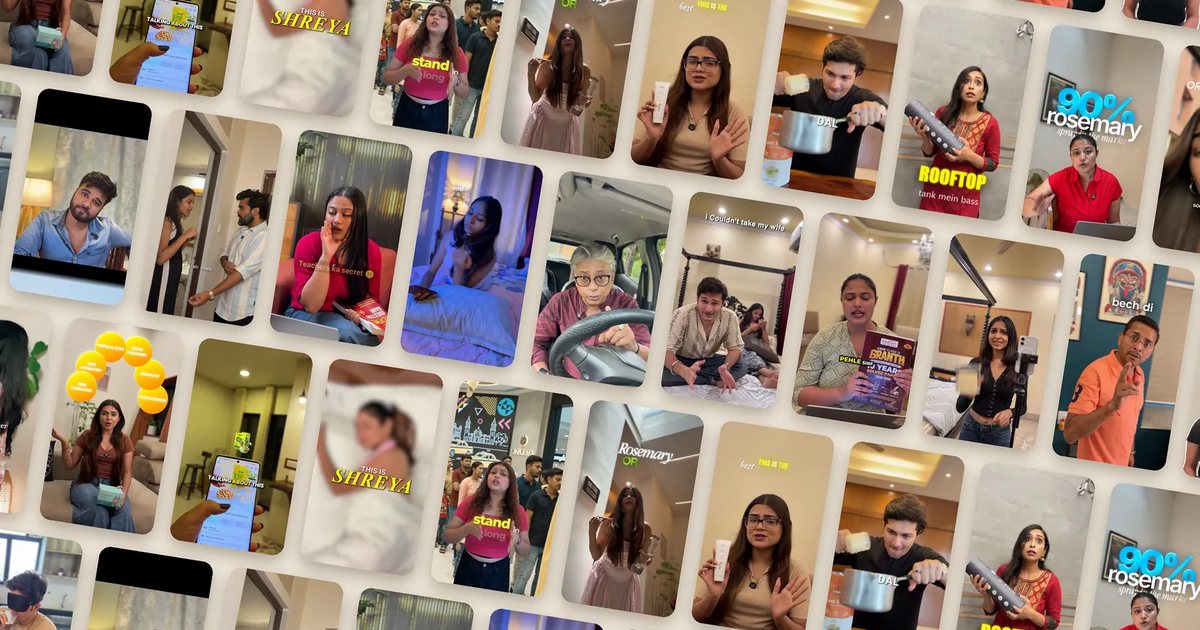
Andromeda is the retrieval stage of Meta's ad delivery system. For each person, it narrows tens of millions of eligible ads down to a few thousand candidates, and later ranking models then choose which ad to show. There is no Andromeda setting, report or creative rule in Ads Manager. In practice, the system now reads your ads closely enough that near-identical variations behave like one ad, and genuinely different concepts give it more ways to match your product to the right people.
Most of what circulates about "the Andromeda update" comes from creator videos and courses, not from Meta. This guide separates what Meta has actually published from what people have added, and turns the useful part into a creative plan for Indian brands.
What is Meta Andromeda, in plain terms?
Every time someone opens Instagram or Facebook, Meta has to pick one ad out of an enormous pool. It does that in stages:
| Stage | What happens | What you control |
|---|---|---|
| Eligibility | Your targeting rules decide who may see the ad at all | Location, minimum age, language, exclusions, customer lists |
| Retrieval (Andromeda) | Picks a few thousand likely candidates for this person out of tens of millions | Nothing directly; your creative is what it reads |
| Ranking | Larger models predict which candidate this person is most likely to act on | Creative quality, conversion signals, landing page |
| Auction | Your bid and the predicted value decide who wins the slot | Budget, bid strategy, optimisation event |
If your ad does not make it through retrieval, ranking never sees it. That is why Andromeda matters even though you cannot touch it.
What has Meta actually said about Andromeda?
Two engineering posts, both written for engineers, not advertisers.
December 2024. Meta introduced Andromeda as the engine "selecting ads from tens of millions of ad candidates into a few thousand relevant ad candidates". It reported a 6% recall improvement in retrieval, an 8% ads quality improvement on selected segments, and a 10,000x increase in model capacity.
28 October 2026. Meta described the latest version: the system "scores every eligible ad with near ranking-level model performance at retrieval scale" at over one billion ads per second, which Meta calls a 100x lift over the 2024 system. It also stated: "Since 2025, Meta Andromeda has delivered a 2.4% increase in conversions on Facebook." For advertisers, Meta's only message was "better performance automatically".
What does the Andromeda update not say?
Plenty of advice now carries the Andromeda label without coming from Meta. Before you restructure anything, know what the posts do not contain:
- No number of ads to run. Neither post tells you how many ads per ad set or how many concepts you need.
- No "Andromeda 2.0". That is a creator label. Meta calls it the latest iteration of Andromeda.
- "Scores every eligible ad" is not "shows every ad". It describes the retrieval stage. Spend still concentrates on the ads the system rates highest.
- No targeting option was removed by this update. Your hard rules (location, age, language, exclusions) still decide who is eligible.
- The 2.4% is not a forecast for your account. It is a Facebook-wide figure with no method or baseline published. If you restructure and launch new ads in the same week, nothing in Ads Manager can tell you which one moved the result.
Why does creative diversity matter more now?
Because the retrieval and ranking models match people to what is actually in the ad: who is speaking, what problem they name, what the product does on screen, what the words say. Meta's own guidance on similar creative is blunt: when ads are too alike, the system may not recognise them as different and can deliver them to the same people. Ten ads that share footage and differ only in headline colour, music or a discount sticker give the system one idea to match, not ten.
Different concepts do the job that detailed targeting used to do. An ad where a working mother talks about a two-minute morning routine reaches different people from an ad where a dermatologist explains the active ingredient, even inside the same broad audience.
What counts as a genuinely different ad?
A useful test: does it change the reason to buy, the person it speaks to, or how it opens and what format it uses? If not, it is a variation.
| Change | New concept or variation? | Example (a skincare brand) |
|---|---|---|
| New reason to buy | New concept | "Fades marks" vs "safe for sensitive skin" |
| New person and moment | New concept | College student before exams vs new mother at 6 am |
| New format | New concept | Talking-head review vs side-by-side texture test vs unboxing |
| New opening on the same body | Hook variation, worth testing | Same demo, three different first lines |
| New colour, music, crop, sticker or headline | Variation | Same footage, different caption style |
Variations still help an ad stay fresh and fit different placements. They just do not count as new ideas.
How should Indian brands plan creative now?
1. Count angles, not ads. Export the last 30 days of ads with their primary text and format. Group them by reason to buy, person addressed and opening line, then count the groups. Most accounts find far fewer angles than ads, and several ads opening with the same line.
2. Brief the missing people and moments. India is not one audience. A metro professional, a tier-2 parent and a first-time online buyer have different reasons to buy, and often different languages. Each is a concept, not a variation.
3. Consolidate the structure. Meta's learning phase needs about 50 optimisation events a week per ad set. Splitting a modest budget across many interest ad sets starves all of them. Fewer ad sets with more distinct creative inside each usually feeds the system better.
4. Keep a pipeline, not a launch. Winning ads fatigue. Plan new concepts every month and new hooks on proven bodies in between. Our plans are built around this: six master videos with three hooks each every month, the first set in 15–20 days and every set after in 15 days, with single hook refreshes in 5–7 days for retainer clients.
5. Prove changes with a test. If you restructure, run Meta's A/B test in Experiments (old setup vs new, two weeks or more, cost per result as the key metric) rather than crediting an "Andromeda lift".
Is targeting dead after Andromeda?
No, but its job has narrowed. Use targeting for rules that must hold: where you deliver, the minimum age, the language, existing customers to exclude. Let the creative do the work of finding the right people inside those rules. Interest stacking to "find" your buyer matters much less than giving the system several clearly different ads to work with.
Frequently asked questions
Is there an Andromeda setting in Ads Manager?
No. Andromeda runs for every advertiser automatically. There is no toggle, column or report for it.
How many ads should I run per ad set?
Meta does not publish a number. Aim for several genuinely different concepts per ad set, each with a few hook variations, and enough budget that each ad set gets around 50 results a week.
Did the October 2026 update change what I should do?
Not in any way Meta spelled out. It made retrieval faster and more accurate. The practical advice (distinct concepts, consolidated structure, steady creative supply) was already sound before it.
Does Andromeda favour UGC over studio ads?
Meta has not said so. What it rewards is creative the models can match to people and that people respond to. Creator-led videos tend to give it more to work with: a real person, a specific problem, the product in use.
Where to go next
For the measurement side, read our guide to hook rate in Meta ads. For the full creative playbook, see UGC ads on Meta in India. To see how a monthly set of six concepts with three hooks each is planned and read, see how we work, check pricing, or book a strategy call.