FinTech brands face a trust problem that most consumer categories don't. Telling someone to link their salary account, invest through an app, or take a personal loan at 14% APR requires believability that a polished brand ad simply cannot manufacture. That's where a well-executed testimonial-style UGC video does what a ₹5 lakh brand film can't, it sounds like a real person who made a real decision and lived with the results.
But filming for FinTech isn't the same as filming for a skincare unboxing. ASCI's 2023 guidelines on financial advertising, RBI's fair-practices code, and the sheer complexity of products like mutual funds, BNPL, and insurance mean your creator needs a tighter brief, a smarter setup, and very specific language guardrails before the phone ever starts recording. Here's how to do it properly, start to finish.
Step 1: Choose the Right Creator Profile for FinTech
Don't default to lifestyle influencers with 500K followers. For FinTech testimonials, the creator's credibility must be plausible to the viewer. A salaried professional in Bengaluru or Pune talking about how she used a zero-balance account to automate her SIP contributions is more persuasive than a macro-influencer who clearly has a brand deal attached.
- Nano and micro creators (5K–100K followers) consistently outperform on trust metrics for financial products. Their audience knows them personally or professionally.
- Look for creators who already talk about personal finance, even casually. A creator who has posted about their first FD or a home loan EMI calculation has existing authority with their audience on money topics.
- Match the creator's demographic to the product. A student-age creator works for a spend-tracker or student credit card (like HDFC Millennia); a 28–35 salaried professional works for term insurance or a wealth app like Groww or INDmoney.
- Hindi, Tamil, and Telugu-speaking creators have disproportionate reach in Tier 2 markets where FinTech adoption is currently growing fastest, cities like Jaipur, Coimbatore, Visakhapatnam. Don't over-index on English-only creators.
Step 2: Write a Legally Safe, Conversion-Focused Brief
This is where most FinTech UGC campaigns fail before filming even begins. ASCI guidelines (updated 2023) require that financial advertisements, including influencer content, must not make unsubstantiated claims about returns, must carry required disclosures (like "mutual fund investments are subject to market risks"), and must not imply guaranteed income from investment products.
Your brief needs to do two things simultaneously: give the creator a believable human story to tell, and give them exact language to use or avoid.
- Approved talking points: What features can they mention by name? (Zero-commission trades, instant KYC, UPI-linked savings.) Keep this list to 3–4 so the video doesn't sound like a spec sheet.
- Mandatory disclosures: For mutual fund or insurance products, provide the exact SEBI/IRDAI disclaimer text and specify whether it goes in the caption, as a spoken line, or as an on-screen text overlay. Don't leave this to the creator to figure out.
- Banned language list: Phrases like "guaranteed returns," "double your money," "zero risk," or specific ROI percentages that can't be substantiated must be explicitly off-limits in writing.
- The story spine: Give the creator a clear before/after narrative: what financial friction did they face, what specific feature solved it, how does their life look now? This is the emotional engine of the testimonial.
In our production work with FinTech clients, we've found that the brief needs a "red lines" section alongside the talking points, a short list of phrases the creator must never say. Clients who skip this section almost always need a reshoot after legal review.
Step 3: Set Up the Shot for Maximum Credibility
Testimonials filmed in obviously staged environments, a bright softbox studio, a living room that looks rented, read as ads immediately. The goal is environmental authenticity without sacrificing technical quality.
- Location matters enormously. A creator talking about a business loan while sitting at their actual shop counter, or discussing a trading app while at a desk with their laptop open, is intrinsically more believable. Scout or request this kind of setting in the brief.
- Use natural light intelligently. Window light on a bright morning, creator sitting 1–2 feet from the window, camera perpendicular to it, gives a clean, warm look on any modern smartphone (iPhone 14+, Samsung S23+, or even a Redmi Note 13 Pro in good light). This costs nothing and looks more real than rented lighting.
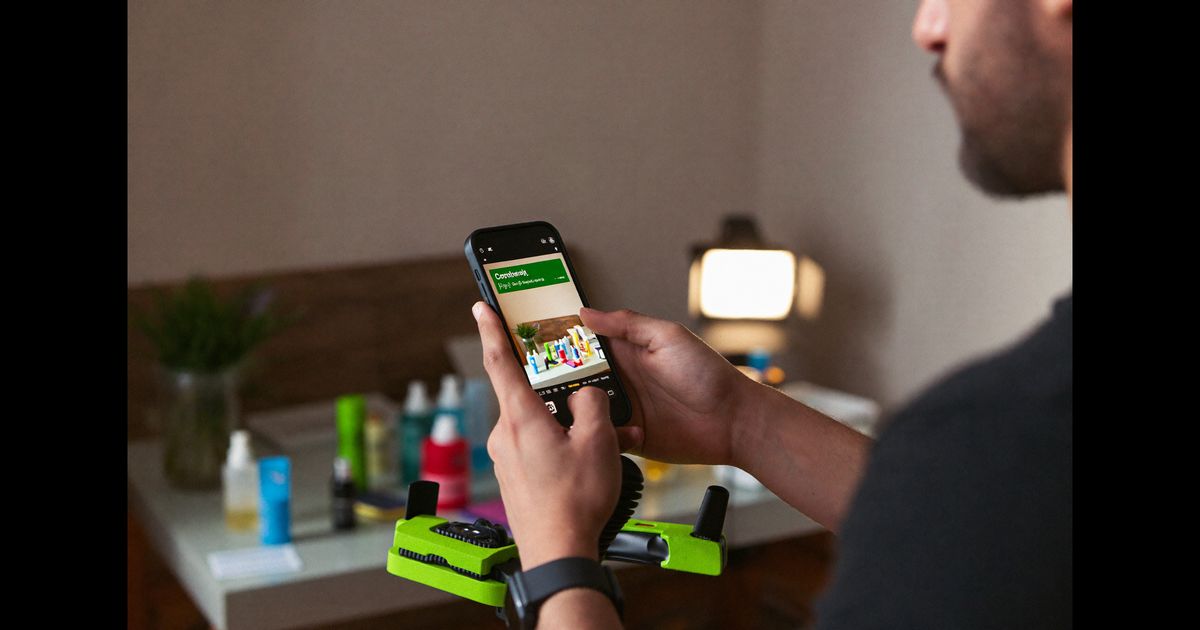
- Frame the product in the shot. If the testimonial is about an app, the creator's hand holding their phone with the app open, or a laptop screen visible in the background, anchors the product without a forced demo. Avoid holding the phone directly at the camera like a product shot; it breaks the conversational feel.
- Audio is non-negotiable. FinTech testimonials often contain precise information (account names, percentage rates, feature names). A ₹1,500 lapel mic clipped under the collar, or a good wired earbud mic, is the minimum. Ambient noise from a cafe or street makes precise financial claims hard to hear and undermines trust.
- Aspect ratio and length. Film vertical 9:16 for Instagram Reels and YouTube Shorts (the primary distribution for testimonials under 60 seconds), but also capture a 16:9 cut if the client wants the footage for paid Meta campaigns. A 45–75 second final cut is optimal for FinTech testimonials, long enough to tell a complete story, short enough to retain the viewer through the disclosure.
Step 4: Direct the Creator on Delivery and Pacing
Testimonial-style UGC falls apart when the creator sounds like they're reading a script. The irony is that a well-structured brief enables a more natural delivery, because the creator isn't trying to remember product specs in the moment.
- Record the hook separately. Ask the creator to record 3–4 different opening lines before they do the full take. The first 3 seconds decide whether the viewer stays. A good FinTech hook is specific and personal: "I used to keep three separate savings accounts to track my goals, here's what I do now" beats any generic opener.
- Shoot in short segments, not one long take. Ask the creator to talk about the problem, pause, then talk about the solution, pause, then the outcome. Edit these segments together. Natural speech patterns with actual pauses are more authentic than a continuous performance.
- Coach on eye contact. Looking directly into the lens, not at a teleprompter text pasted below it, is the single biggest delivery factor. We brief creators to tape a small dot above the camera lens so their eyes land naturally.
- Avoid scripted enthusiasm. Phrases like "I am absolutely loving this app!" sound paid. Coach creators to use measured, specific language: "What I actually use every week is the auto-invest feature, it moves ₹2,000 into my liquid fund every Monday without me touching it."
Step 5: Edit for Platform and Compliance
FinTech testimonials have an editing step that most other categories skip: compliance review. Before the video goes live, the final cut needs a pass from the brand's legal or compliance team. Build this into your timeline, typically 2–3 business days for an NBFC or regulated entity.
- On-screen text for disclosures. Use a clean, legible font at 10–12% of screen height for mandatory SEBI/IRDAI disclosures. Place them at 2–3 second intervals, not in a 0.5-second flash at the end. ASCI guidance is clear that disclosures must be readable.
- Caption disclosures. For Instagram and YouTube, include the required disclosure text in the first 125 characters of the caption so it's visible before "more" is clicked. The creator's caption should open with this if the product requires it.
- B-roll of the app UI. A 5–8 second screen-recorded clip of the relevant app feature (e.g., the SIP setup screen, the loan disbursement confirmation) cuts cleanly into the testimonial after the creator names the feature. This is practical, not promotional, it shows the viewer exactly what's being talked about.
- Paid partnership tags. Instagram's paid partnership label is mandatory for sponsored content under ASCI rules. Ensure the creator adds it before publishing. For Meta paid amplification, the creator must also authorise the brand as a business partner so the ad can run from the creator's handle.
Step 6: Amplify on the Right Platforms and in the Right Language
Once the testimonial is live, its organic reach is just the starting point. The real value in FinTech UGC is paid amplification, whitelisting the creator's post and running it as a dark post or branded content ad on Meta or YouTube.
- Meta Advantage+ with creator whitelisting lets you run the testimonial video as a paid ad from the creator's account. It retains the social proof (follower count, organic comments) while reaching a targeted audience. For a FinTech brand, this might be salaried professionals aged 25–35 in Mumbai, Delhi, Hyderabad, and Bengaluru.
- Language-specific cuts. If you filmed in Hindi, consider subtitling the same video in Tamil or Telugu for paid distribution in Tamil Nadu and Andhra Pradesh. FinTech adoption in these markets is significant and the cost of a subtitled cut is minimal compared to filming a new video.
- YouTube pre-roll for high-intent audiences. Testimonial videos performing well as organic Reels can be repurposed as 30–60 second skippable pre-roll ads on YouTube, targeting personal finance content channels. A creator testimonial in pre-roll format consistently outperforms brand-produced ads in view-through rate for financial products.
- Retargeting audiences: Upload the video to Meta, build a video-view audience (people who watched 50%+), and retarget them with a harder conversion ad, a direct sign-up or download CTA. The testimonial warms the audience; the retargeting closes.
If you're a FinTech brand looking to build a library of credible, compliance-ready testimonial videos with Indian creators who understand the category, take a look at our recent work, or book a consultation to talk through a brief for your next campaign.