Pick up your phone right now and open YouTube Shorts, Instagram Reels, or Moj. Within ten seconds, you will scroll past at least three videos where someone is holding a product, talking directly to you, and making you want to buy it. That format, raw, vertical, fast, personal, is Shorts-style UGC, and it is currently the most cost-effective creative format available to Indian e-commerce brands. If you have never made one before, this guide walks you through every practical step from setup to upload.
The good news is that you do not need a studio, expensive equipment, or any prior filming experience. What you do need is a clear understanding of how these short videos are structured, why they work, and what separates a high-converting creator video from one that gets swiped past in under two seconds.
What "Shorts-Style UGC" Actually Means
Before we get into technique, let us be precise about the format. Shorts-style UGC (user-generated content) refers to vertical videos, typically 9:16 aspect ratio, between 15 and 60 seconds long, filmed in a casual, authentic style by real people (creators, customers, or everyday consumers) rather than production crews. The word "Shorts" comes from YouTube Shorts, but the same format lives across Instagram Reels, Moj, Josh, and Snapchat Spotlight.
For e-commerce brands, this format matters because it fits naturally inside the feeds where Indian shoppers are already spending time. A woman in Jaipur watching a Reel about a kumkum powder that actually does not stain her dupatta, or a student in Pune watching a 45-second video of someone unboxing a budget mechanical keyboard, these are genuine discovery moments that lead directly to purchases. The creator does not feel like an advertiser; she feels like a friend.
Your Phone Is Enough, Here Is How to Set It Up
Most professional UGC for Indian brands is filmed on a mid-range or premium Android or iPhone. You do not need a mirrorless camera. What you do need is attention to three basics:
- Light first, everything else second. Sit or stand facing a window during daylight hours. A north-facing window in the morning gives the softest, most flattering light. If you are filming at night, a Rs. 800–1,200 ring light from Amazon or Flipkart placed at eye level makes an enormous difference. Avoid overhead tube lights; they flatten your face and make skin look sallow.
- Record at 1080p, not 4K. 4K files are large and often get compressed aggressively when uploaded to Reels or Shorts anyway. 1080p at 60fps gives you sharp, smooth footage that survives platform compression better.
- Clean your lens. It sounds trivial, but a smudged lens is the single most common reason beginner creator videos look amateurish. Wipe it with a soft cloth before every shoot.
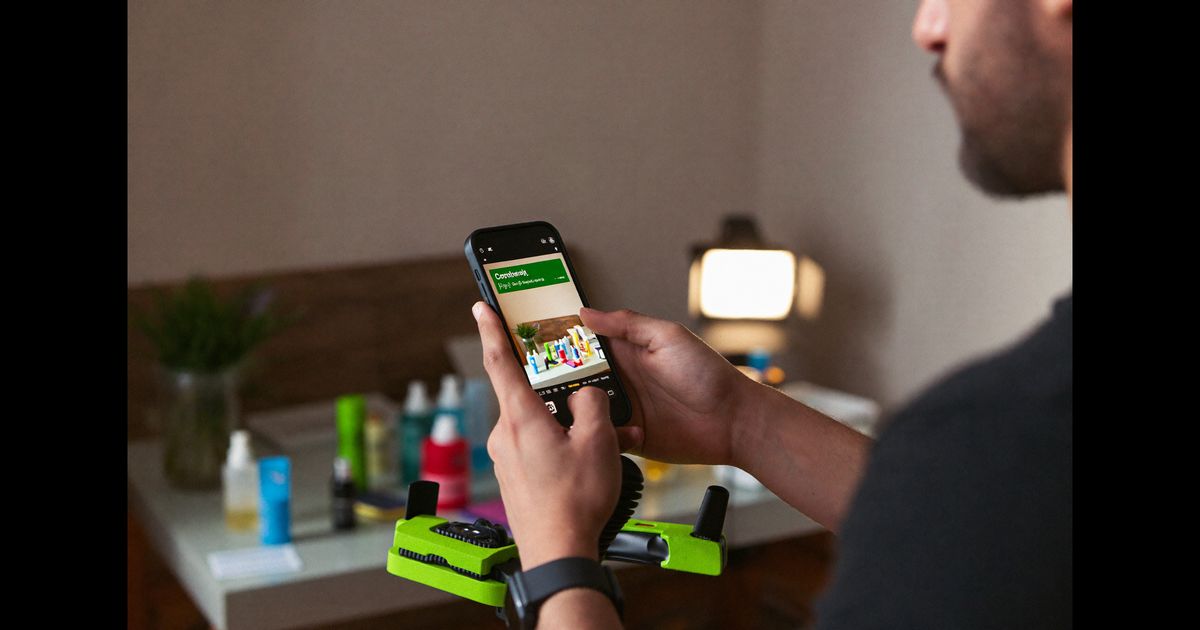
- Use a phone stand or mini tripod (Rs. 300–600) for static shots. Handheld works for walking shots and lifestyle b-roll, but product demos need a stable frame. A stable frame reads as confident.
- Background matters more than you think. A clean white wall, a tidy desk, a kitchen counter with a plant, these work. A cluttered room with laundry in the background does not, even for "authentic" UGC.
The Structure of a High-Performing Shorts-Style Video
Every effective Shorts-style UGC video has the same skeleton, even when the tone and product category are completely different. Here is how to think about each second:
- 0–3 seconds: The hook. This is non-negotiable. You have to earn the next 40 seconds in the first three. The hook can be a surprising visual (pouring the product, an unexpected before), a bold spoken statement ("I returned four moisturisers before I found this"), or a piece of on-screen text that poses a question your target viewer is already asking. We brief creators to start mid-action, already doing something with the product, rather than opening with "Hey guys, so today I am going to talk about..."
- 3–20 seconds: The problem or desire. Name the specific frustration or aspiration. "My hair gets frizzy the moment I step outside in Kolkata's humidity" is specific. "I have a hair problem" is not. Specificity makes viewers feel seen, which keeps them watching.
- 20–45 seconds: The product demonstration. Show, do not just tell. Apply the product, use the app, unbox and hold up each item, demonstrate the before-and-after. Keep cuts tight, no pauses, no "um", no dead air. Natural speech with small imperfections is fine; hesitation and dead space are not.
- 45–60 seconds: The payoff and soft close. What is the result? What does the viewer need to do next? This is where you include a verbal or on-screen call-to-action. For ads, this means a clear directive: "Link in bio" or "Available on Flipkart now." For organic UGC, it can be as light as "This is my new go-to, highly recommend."
Language, Tone, and Code-Switching for the Indian Market
One of the most powerful tools available to Indian creators is the ability to move between languages within a single video. A creator speaking Hindi with a few English product terms dropped in ("bhai, the texture is so lightweight, yaar") sounds exactly like how her audience actually talks. This code-switching, what linguists call Hinglish, Tanglish, Benglish, or Minglish depending on the region, is not sloppy; it is culturally precise.
When briefing creators for Indian e-commerce brands, the language guidelines we typically use are:
- Match the creator's natural spoken register. Do not force pure English if the creator normally speaks Hindi or Tamil. Forced English sounds like a corporate voiceover, not a recommendation.
- On-screen text (captions, callouts) can be in English even when the spoken audio is regional, because Indian viewers are trained to read English captions across multiple regional-language videos.
- For pan-India brands, Hindi-dominant Hinglish is the widest reach. For South Indian markets (Bengaluru, Chennai, Hyderabad, Kochi), local-language hooks followed by English or Hindi demonstration sections tend to outperform pure English.
ASCI Guidelines: What You Cannot Say in Ads
If this video is going to be used as a paid ad (boosted Reels, YouTube Shorts ads, Meta Advantage+ placements), the Advertising Standards Council of India (ASCI) rules apply to the creator's script, not just to banner ads. First-time creators are often surprised by this. Key points:
- No unverifiable claims. "Removes 100% of dark spots in 7 days" requires clinical substantiation. If the brand cannot provide it, the creator cannot say it. Use "visibly reduced" or "I noticed a difference in two weeks" instead.
- Disclosure is mandatory. If the creator is paid or gifted product, the video must carry a disclosure. On Reels and Shorts, the accepted format is the platform's built-in "Paid Partnership" or "Branded Content" tag plus a verbal or on-screen label like "#Ad" or "#Sponsored". ASCI's 2021 influencer guidelines made this enforceable; non-disclosure can result in the brand being penalised.
- Health and cosmetic claims need care. Skincare, haircare, supplements, and food products are under heightened scrutiny. Phrases like "dermatologically tested" or "clinically proven" require the brand to have actual documentation ready.
- Financial products and edtech have additional SEBI and UGC (education regulator) considerations beyond ASCI. If you are creating videos for a fintech app or an online course platform, check both sets of rules before scripting.
Common Mistakes That Kill Watch Time
After reviewing hundreds of creator submissions in our production work, the same errors appear repeatedly. Knowing them in advance saves you reshoots:
- Opening with your face in silence. If the first half-second is just you looking at the camera saying nothing, viewers swipe. Start speaking or start moving before you even hit record, and trim the dead frame in editing.
- Holding the product awkwardly. If the product label faces away from the camera, you have wasted the shot. Before recording a product demo, rehearse the grip and rotation so the brand name or key visual is always camera-facing.
- Monotone delivery. Text-to-speech TikTok culture trained some viewers to accept flat delivery, but Indian audiences respond strongly to expressive, warm vocal tone. Smile when the product works. React genuinely. You are not reading a report.
- No captions. A large share of Reels and Shorts are watched on mute, on public transport, in offices, late at night. Auto-captions on Reels and YouTube are imperfect, especially for Hinglish. Review and correct them before publishing.
- Overshooting the time limit. A 75-second Reel on a topic that could be covered in 45 will lose most of its audience before the call-to-action. Edit ruthlessly. If a sentence does not add information or emotion, cut it.
The Editing Workflow: Fast Cuts, Captions, and Music
You do not need CapCut Pro or Adobe Premiere for Shorts-style UGC. Most creators working with Indian e-commerce brands use one of these:
- CapCut (free, iOS and Android), the most widely used tool for this format. Auto-captions, beat-sync cuts, and template libraries make it beginner-friendly. The auto-caption feature supports Hindi, Tamil, and several other Indian languages.
- Instagram's native editor, good for simple Reels with text overlays, stickers, and music from the Instagram library. The limitation is that you cannot do frame-accurate cuts as easily as in a dedicated app.
- VN Video Editor (free), popular among creators who want timeline-based editing without paying for a subscription.
For music: use only royalty-free tracks or music from the platform's licensed library (Instagram Music, YouTube Audio Library). Using a Bollywood track or a trending film song without a licence will get your video muted or taken down, and if it is a paid ad, the brand's account can be penalised. Meta's Sound Collection and YouTube's Audio Library both have quality tracks that work well under product demos.
A practical rule for pacing: match your cut frequency to your energy level. High-energy product categories (fitness, fashion, snacks) sustain cuts every 1–2 seconds. Lifestyle or skincare content can breathe at 3–5 seconds per cut. Watch two or three top-performing Reels in your product category before editing, your intuition will calibrate fast.
Briefing Yourself or Another Creator
Whether you are filming yourself or working with a hired creator, a brief prevents wasted takes. A good brief for a Shorts-style UGC video for an Indian e-commerce brand should include: the product and its single most important benefit (not a list of ten features), the target viewer (who she is, where she is, what she cares about), the mandatory visual moments (show the packaging, show the texture, show the result), the platform and aspect ratio, the disclosure requirement if it is a paid collaboration, and any prohibited claims per ASCI or brand legal. One A4 page or a voice note is enough, you do not need a 20-page production document for a 45-second video.
If you are building a portfolio as a new UGC creator, start with three product categories you genuinely use, skincare, kitchen tools, apparel, whatever fits your daily life. Film one video per product, follow the structure above, and post them as organic content before approaching brands. Brands and agencies can see immediately whether a creator understands the format; a portfolio of three well-structured Shorts-style videos will outperform a pitch deck every time.
If you are a brand looking to commission Shorts-style UGC at scale, or a creator wanting to understand how agencies brief and quality-check this format, take a look at how we work at The UGC Agency. Our production process covers scripting, creator matching, and multi-platform delivery for e-commerce brands across India.