Indian Shopify D2C stores that systematically use UGC on both Meta ads and on-site product pages report a 22-38% lift in conversion rate vs studio-image-only competitors. The double-layered effect, UGC drives the click from Meta, UGC on the PDP closes the purchase, is the highest-leverage 2026 ecommerce optimisation. But most Shopify founders bolt UGC onto only one half of the funnel. This guide covers the full implementation: which on-site UGC placements actually move conversion, which Shopify apps integrate UGC properly (and which are bloat), how the Meta-to-PDP retargeting flow should connect, and the 7-step rollout sequence.
TL;DR
- UGC works on Shopify in two distinct layers: Meta ad creative (top of funnel) + on-site placements (bottom of funnel). Both matter.
- On-site UGC placements that lift conversion most: product page video carousel, customer-reviews-with-photos, post-purchase upsell, and homepage hero strip.
- The 4 best Shopify apps for UGC integration: Loox, Judge.me, Pixlee, EmbedSocial, each with different trade-offs.
- Meta-to-PDP retargeting flow: cold UGC ad → PDP with UGC reviews → cart-abandon retargeting ad → checkout-completion email.
- Average lift from on-site UGC alone (no ad change): 14-22% CR uplift on product pages.
- Lift from UGC-driven Meta ads alone (no PDP change): 35-60% CPA reduction.
- Combined lift (both layers): 22-38% net conversion improvement at the store level.
1. The two-layer UGC model for Shopify
Most Shopify founders think of UGC as "Meta ad creative." That's half the play. The other half is on-site:
Layer 1: Meta ad creative. 9-15 second UGC Reels driving cold traffic to the store. CPA-optimised. The job: get the click.
Layer 2: On-site UGC. Customer videos, photo reviews, real-user testimonials embedded on the product page, homepage, and post-purchase pages. The job: close the conversion + raise AOV.
Brands that nail one but skip the other leave 30-50% of available conversion lift on the table.
2. On-site UGC placements that actually move conversion
- Product page video carousel (above the fold, after main product image). 2-4 UGC videos showing real users with the product. CR lift: +12-18%.
- Customer reviews with photos (mid-page). Reviews that include photos convert 38-52% better than text-only. Use Loox or Judge.me for collection.
- "How real customers use this" module (mid-page). Curated 3-5 UGC clips with brief captions. CR lift: +7-12%.
- Cart-page social proof: "[N] customers bought this in the last 24 hours" + 1-2 mini UGC testimonials. AOV/CR lift: +5-9%.
- Post-purchase upsell page: UGC showing complementary product use. AOV lift: +18-28%.
- Homepage hero strip (rotating UGC carousel). Brand-trust signal. Modest direct CR impact but lifts category-page click-through by 11-17%.
3. The 4 Shopify apps worth installing for UGC
Loox: Best for collecting + displaying photo reviews on product pages. Strong India support, ₹650-₹2,400/month plans. Native video upload with 2025+ updates.
Judge.me: Alternative to Loox. Slightly cheaper (₹500-₹2,000/month), strong on text+photo. Slightly weaker on video display.
Pixlee: For embedding curated UGC carousels on product pages. Better for brands with consistent inbound UGC; overkill for stores under ₹3Cr revenue.
EmbedSocial: For embedding Instagram-pulled UGC feeds. Useful when you want a "real customers on Instagram" social-proof block. Less useful if you're running paid UGC (because you control distribution anyway).
Skip: bloated all-in-one "social proof" apps that add 2-3 seconds to page load. Page speed loss eats the UGC conversion gain.
4. The Meta-to-PDP UGC retargeting flow
The optimal full funnel for a Shopify D2C store in 2026:
- Cold prospecting: UGC Reel on Meta, hook-pattern proven, vernacular if applicable. Click → PDP.
- PDP arrival: page loads with main product image + UGC video carousel above the fold + photo reviews mid-page.
- Add-to-cart: cart-page shows "[N] customers ordered today" + 1-2 mini UGC clips. Checkout incentive (free shipping above ₹X) visible.
- Cart-abandon retargeting (Meta + WhatsApp): UGC Reel from a different angle (if first ad was "problem-solution," this is "before/after") + free-shipping nudge.
- Checkout completion email: thank you + UGC clip showing post-purchase use + upsell recommendation.
- Day-7 post-purchase email: request UGC review with Loox/Judge.me. Offer 5-10% next-purchase discount for video review.
- UGC collection: feed back into the asset library for future ad rotation + on-site placements.
The funnel compounds, every customer becomes a potential UGC contributor, every UGC contributor becomes a conversion lever on future buyers.
5. The 7-step Shopify UGC implementation rollout
Week 1: Foundation audit. Map current product page layout. Identify where UGC will live. Check page-speed baseline (must stay under 3 sec load time).
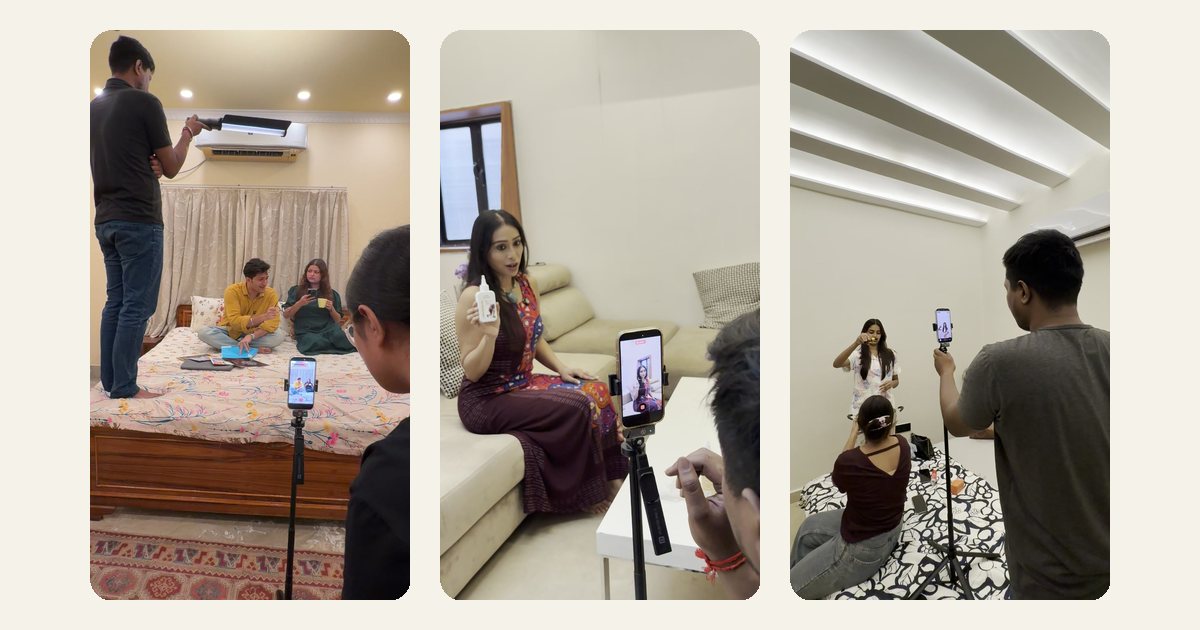
Week 2: Source the first 12 UGC videos. Via your existing customers (offer ₹500-₹2,000 + free product for a 30-sec phone video) or via a UGC agency for proven-quality video.
Week 3: Install + configure Loox + Judge.me. Start photo + video review collection on every post-purchase. Email flow auto-triggers 7 days post-delivery.
Week 4: Add UGC video carousel to top 5 product pages. Use a lightweight gallery widget. Make sure videos lazy-load (don't block first paint).
Week 5: Launch UGC Meta ads. 8-12 variants of cold UGC Reels driving to UGC-rich PDPs. Track CR at the PDP level, should already see lift from the on-site UGC even before this.
Week 6: Cart-abandon UGC retargeting set up. Different UGC angle than cold prospect ad. Personal-handle whitelisting if available.
Week 7+: Optimise + scale. Identify top-performing UGC clips across both layers. Rotate weak ones out. Build to 30+ UGC assets in the library by month 3.
6. Common Shopify+UGC mistakes
- Heavy autoplay videos that crash mobile. Mobile Shopify shoppers are 70%+ of Indian D2C traffic. Force-autoplay 4 videos on a PDP and you'll see a 18-25% mobile bounce-rate spike. Use poster images + click-to-play.
- Slow-loading review widgets. Loox/Judge.me are well-optimised. Bloated "all-in-one social proof" apps are not. Test page-speed before and after every app install.
- UGC videos without sound captions. Most mobile shoppers browse silent. Burn captions into UGC videos before uploading.
- Star-rating manipulation. Hiding negative reviews via the app. Shopify's 2025+ guidelines and Indian Consumer Protection Act both flag this. Don't.
- One UGC video used everywhere. Same 15-sec clip on ad + PDP + email = ad fatigue across funnel layers. Different UGC per funnel stage.
- Skipping post-purchase UGC collection. Most stores ask for written reviews only. Video review request (with incentive) brings 12-25% video review rate, building free UGC supply over time.
- Forgetting GDPR/ASCI compliance. If you use a customer's photo/video review in a Meta ad, you need explicit consent for that use. Loox/Judge.me have consent toggles; turn them on.
7. Frequently asked questions
Q: Does on-site UGC actually impact Shopify conversion rate?
Yes, typical lift is 14-22% from on-site UGC alone (product page video + photo reviews + social-proof modules). The lift is largest in beauty, fashion, fitness, food. Smaller in fintech-app-style stores.
Q: How do I get UGC videos from real Shopify customers?
Post-purchase email with incentive (₹500-₹2,000 voucher or free product). Conversion rate: 8-15% of recent buyers will record + submit a 30-second video review when incentivised correctly. Build the library over 3-6 months.
Q: Which Shopify theme works best with UGC video?
Dawn (Shopify's default 2.0+ theme) handles UGC video carousels well. Premium themes like Impulse and Symmetry have native UGC modules. Older themes (Debut, Brooklyn) require custom theme code for video carousels.
Q: Will UGC slow down my Shopify store's page speed?
Only if implemented badly. UGC videos should lazy-load with poster image placeholders, never autoplay above the fold, and use a CDN-delivered video format (Shopify's CDN handles this if you upload via Shopify's native video field). Page-speed loss should be under 0.3 seconds.
Q: Can I run UGC ads to a Shopify product page without changing the PDP?
Yes, and you'll see Meta CPA reduction. But you'll leave the on-site conversion lift on the table. The compounded effect of both layers is 30-50% higher than either layer alone.
Q: How many UGC reviews does my product page need to start moving conversion?
Threshold effect: 3 photo/video reviews is the minimum (below that, the section reads sparse). 8-12 is the sweet spot. 20+ provides diminishing returns. Quality matters more than quantity, 5 strong reviews beat 30 weak ones.
Q: Should the UGC on my PDP match the UGC in my Meta ads?
Related but distinct. Use the same brand-voice and similar creators, but different clips. Showing the exact ad clip on the PDP creates a "I already saw this" effect that reduces conversion.
Q: Do I need different UGC for desktop vs mobile Shopify visitors?
Format yes, content no. Same UGC clips, but: mobile shows vertical 9:16, desktop shows the same content in a 16:9 or square crop. Most modern UGC apps handle this responsive rendering automatically.
Where to go next
For the Meta ad-side patterns that drive cold traffic, see the Meta UGC creative playbook. For per-video pricing to budget your UGC asset library, the UGC rate card. To talk through your specific Shopify store's implementation, book a 20-min consultation.