Indian D2C founders ask us this question every single week: "Should I spend my next ₹2 lakh on a single influencer post, or on UGC video assets I can run as paid ads to my own audience for the next 12 months?"
The honest answer depends on what you're optimising for. Influencer marketing buys you an influencer's organic audience reach once. UGC marketing buys you a content asset you keep, and run as paid ads to your targeted buyer profile, again and again, for as long as the creative performs.
Both have a place. But for the typical Indian D2C brand at ₹50L-₹10Cr revenue running performance-led growth, the cost-benefit math has shifted dramatically toward UGC in 2026. Here's why, with real numbers.
The core difference, in one sentence
Influencer marketing pays for borrowed audience reach. UGC marketing pays for owned content assets.
An influencer post lives on the influencer's handle, drives some traffic during its organic life (typically 24-72 hours), and then becomes inert. The brand has no ongoing right to keep using that content unless explicit usage rights were negotiated upfront (and usually they cost extra).
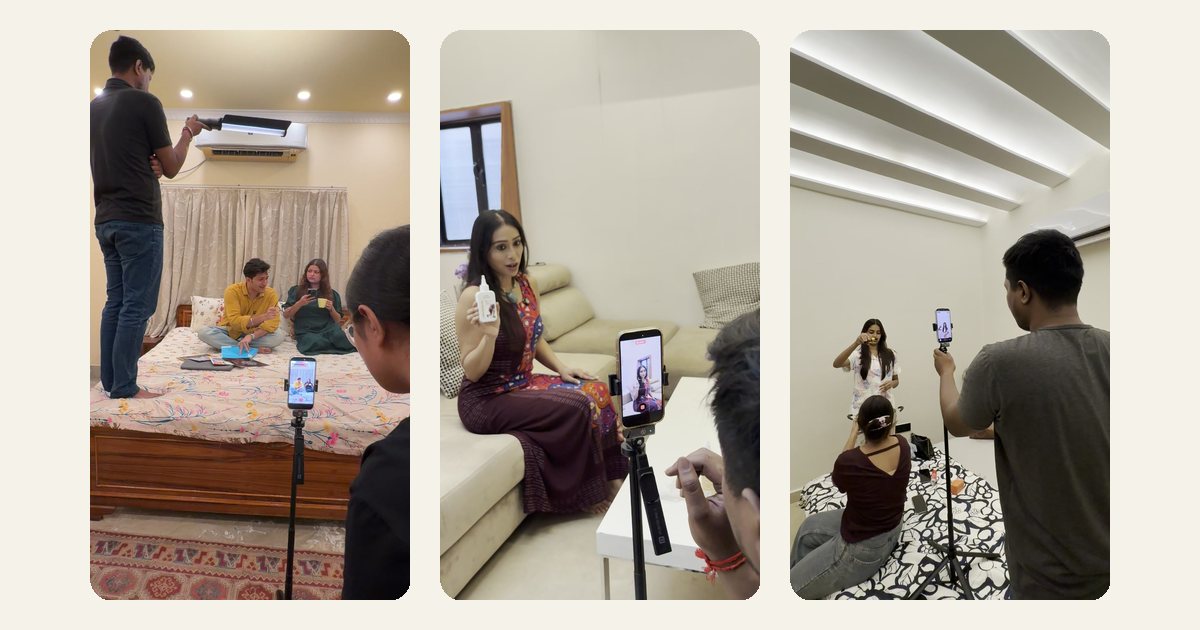
A UGC asset, on the other hand, is produced specifically for the brand to own and use as paid ad creative. Same creator, same authentic style, but you own the file, the usage rights, and the right to run it on Meta, YouTube, Amazon, and Flipkart for as long as it performs.
Cost comparison: ₹2 lakh allocated two ways
Let's take a concrete example. You're a beauty D2C brand at ₹3 crore annual revenue, allocating ₹2 lakh of marketing spend.
Path A, Single influencer post (50K-100K follower beauty creator)
- Cost: ₹1,50,000-₹2,50,000 for a single sponsored Reel
- Reach: 30,000-150,000 views (organic life ~48 hours, then dies)
- Conversion: typical 0.1-0.5% follower-to-purchase rate
- Lifetime: 48-72 hours of meaningful reach
- Content ownership: brand cannot reuse without re-licensing fee
Path B, UGC video asset library (The UGC Agency Growth plan)
- Cost: ₹1,20,000 for 6 master UGC videos, 3 hook variants each
- Reach: depends on your ad spend on top of this, let's say ₹80,000 of remaining budget = ~1.2M-2.5M Meta impressions in India for beauty
- Conversion: typical 1.5-3% ad-to-purchase rate when targeting your buyer profile
- Lifetime: 30-90 days of fresh creative rotation per variant
- Content ownership: full commercial rights, run anywhere forever
For most performance-led brands, Path B delivers 5-15x more buyer-targeted impressions and a content library that keeps working.
When influencer marketing IS the right call
This isn't a one-sided story. Influencer marketing absolutely wins for specific situations:
- Brand launches where awareness matters more than direct conversion. A single 500K-follower influencer endorsement signals trust to a new market.
- Niche communities where the influencer IS the audience, gaming creators, regional language audiences, parenting communities.
- Pre-launch hype where you need talkability and buzz, not just sales.
- One-off cultural moments, a Holi launch, a wedding-season jewelry drop, a festival F&B push.
In those situations, the influencer's organic audience is the asset, not the content.
When UGC marketing is the right call
- Anytime you're running paid social ads (Meta, Instagram, YouTube, TikTok) at meaningful scale (₹2L+ monthly ad spend)
- Anytime your buyer profile is well-defined and Meta can target them directly
- Anytime ad fatigue is killing your performance and you need fresh creative weekly
- Anytime you have product-market-fit pressure and need to test 30-50 creative angles cheaply
- Anytime you need multi-language reach (UGC scales across Hindi, Tamil, Telugu, Bengali, etc. with shared production logistics)
The hybrid play (what we actually recommend)
For most Indian D2C brands at ₹2Cr+ revenue, the right answer is neither/nor. It's both, sized appropriately:
~70% of marketing budget on UGC ads + paid distribution (Meta, YouTube, Amazon Posts). This is the ROAS workhorse.
~20% on strategic influencer partnerships for awareness moments, launch, festive, key product drops.
~10% on creator-led content where the creator gets paid both a creation fee AND a content-rights fee, so you can also run the resulting content as paid UGC ads. This is the highest-leverage spend: you get both the influencer reach AND the ownable content asset.
The compliance angle nobody talks about
ASCI's 2024 Influencer Guidelines apply equally to UGC and traditional influencer content, the "paid partnership" disclosure tag is mandatory. But many Indian brands forget that the disclosure requirement falls on both the creator and the brand, with brand-side liability for misleading claims. We've seen Meta ad accounts get restricted because the influencer skipped a disclosure on Reels they didn't realise was being run as a paid ad.
This is one place UGC has a structural advantage: when you produce UGC through an agency, compliance is baked into the workflow. The brand reviews scripts, the disclosure tag is verified before publishing, ASCI-required language ("paid partnership", "#ad") is non-negotiable. Versus loose influencer briefs where compliance ends up as an afterthought.
Real benchmarks from our Indian clients
Across our Indian D2C clients in 2024-2026, here's the typical numerical pattern we see when brands switch significant budget from pure influencer marketing to UGC ads:
- Meta CPA reduction: 35-60% within 14-21 days
- Cold-prospecting ROAS lift: 3-5x
- Creative lifespan extension: 2-3x longer before ad fatigue
- Cost per ready-to-run ad variant: ~₹3,300 on UGC vs ~₹40,000+ per influencer post
The decision framework, simplified
Ask yourself three questions:
- What's my goal, awareness or conversion? If conversion, UGC wins almost always. If awareness, influencer wins for niche audiences.
- Am I running ≥₹2L/month in paid social ads? If yes, UGC is mandatory infrastructure. If no, start with hybrid.
- Can I name my buyer profile clearly? If yes, UGC + Meta targeting beats influencer reach. If no (you're still defining product-market-fit), influencer marketing helps you discover who buys.
What this looks like in practice
We work with brands across exactly this spectrum. A typical engagement starts with a free 30-minute strategy call where we audit your current ad creative, identify the 3 highest-leverage UGC angles for your brand, and propose either a UGC-only plan or a hybrid budget split with your influencer agency.
Plans start at ₹72,000/month for Starter (6 master videos, 3 hooks each), ₹1,20,000 for Growth (same volume, higher production tier), or ₹2,40,000 for Scale (same volume, DSLR production). All plans include full commercial usage rights with no platform restriction, scripts, multi-format exports, and creator sourcing across our Indian creator network in cities across India.